
Suspenseful and sparked with flashes of humor and joy, The Secret Agent conveys the harsh realities of life under a corrupt and violent dictatorship yet watching the film itself is not grim, but rather a complex and deeply moving experience. Written and directed by Kleber Mendonça Filho, the film is set in Brazil in 1977, during the military dictatorship which lasted from 1964 to 1985. A series of black and white images of everyday life in Brazil, set the tone and announce the era, as the opening title describes the dictatorship as “a time of great mischief”; a wry understatement that hits much harder than a more explicit condemnation. Moving freely between different timelines and diverse genres, Mendonça takes the viewer on a provocative and intricate path, strewn with surprises.
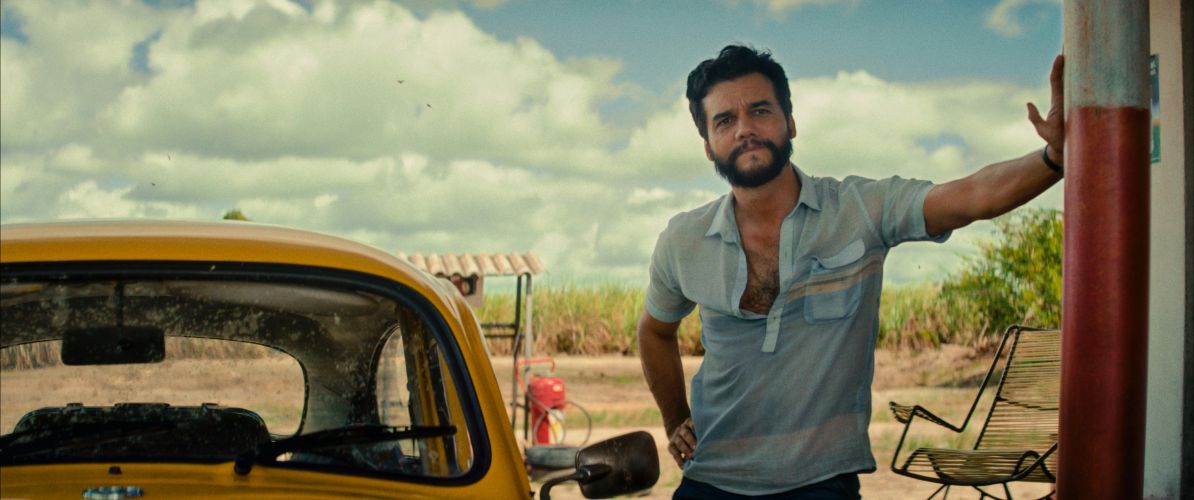
Life and death are juxtaposed at every turn, as Marcelo (Wagner Moura) pulls up to a small gas station in the middle of nowhere, with dead body lying just a few feet away. Unfazed yet curious, Marcelo listens to the harried attendant (Joálisson Cunha) explain that the police have told him they can’t deal with the corpse until after Carnival. Just then, a police car arrives, but they have no interest in the dead body, they are far more intrigued by Marcelo’s bright yellow bug, and the potential to shake him down for some cash, or, if nothing else, his last cigarettes. Marcelo’s calm demeanor reveals the extent to which police corruption has become commonplace, almost expected.
Wagner Moura delivers a powerful performance as Marcelo, whose character is reflected as much in his responses to those around him – the look in his eyes when he listens, as in his own words and actions. Scenes from the past reveal a younger, louder, angrier, Marcelo, while the Marcelo of 1977 is a quieter man who has already experienced loss and injustice, who has learned to hide in plain sight to survive, yet despite it all, has not lost his compassion for others, or his capacity for joy. The latter is most evident when he spends time with his young son, Fernando (Enzo Nunes).
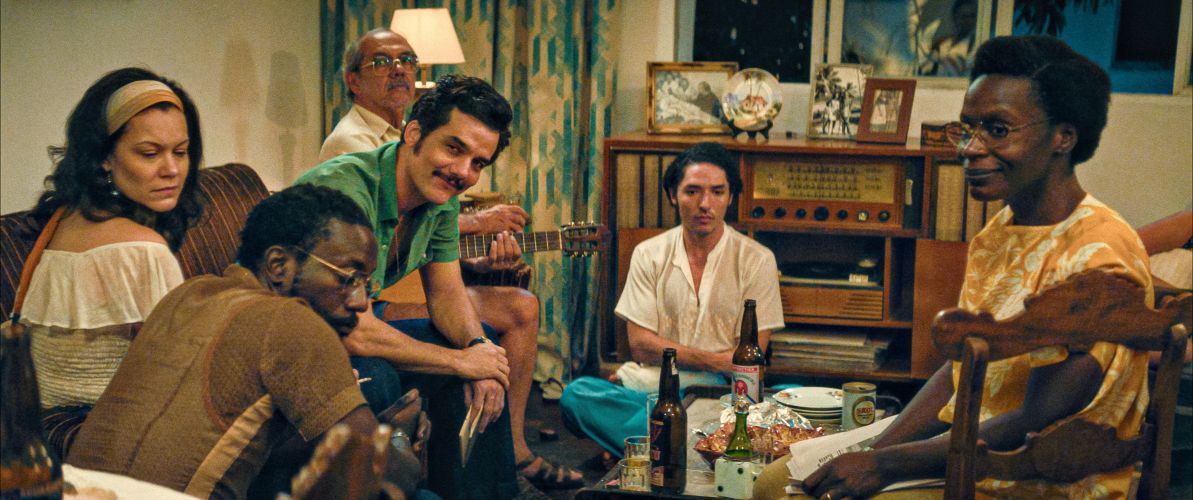
Marcelo has come home to Recife (which is also the hometown of Mendonça) to reunite with his son and embark on a new life. He is taken in by Dona Sebastiana (Tânia Maria), an outspoken septuagenarian who has opened her home to a community of refugees. Everyone there has secrets, including Sebastiana herself, many of them hiding their true names, even from one another. The small enclave is teeming with life and laughter, a haven protected by a network of dissidents. Tânia Maria brings a vital energy to the film as Sebastiana, whether she is proclaiming the ugliness of the cat door, explaining why her latest rescue Clóvis (Robson Andrade) had to escape his father, or matchmaking between the residents.
Marcelo’s situation is slowly revealed as the narrative develops in a nonlinear manner, following different paths. A shark is found that has swallowed a human leg, and Police Chief Euclides (Robério Diógenes) is called away from Carnival celebrations to deal with the matter. The incident generates headlines and noise, as well as a resurgence of interest in the movie Jaws, which comes back to the cinema. Even Fernando, who is deemed too young to see the movie, is fascinated by the poster’s depiction of the shark. Just as Spielberg suggested the ominous presence of the shark through music, the image of the shark, as well as the disembodied leg, contribute to the palimpsest of images and themes that convey the dangers and horrors of the military dictatorship. In a creative departure from the drama, there is a scene in which the leg comes to life, attacking gay men in the park. A reminder that queer people, along with long hair, communists, and freedom, were on the regime’s hate list.
One of the film’s strongest scenes that embodies the extent to which the entire system is permeated with cruelty features Udo Kier in one of his final performances. Police Chief Euclides, who decides to make Marcelo one of his pals, invites him to come along to see Hans (Kier), a German tailor. Refusing the invitation is not an option. Euclides’ idea of fun is having the elderly Hans show them his scars from World War II. Hans attempts to evade Euclides by sequestering himself in an adjacent room, claiming “Estoy cansado” (I’m tired), but Euclides does not give up, mistakenly praising Hans, (a Holocaust survivor) as a German soldier of World War II – in other words, admiring him as a Nazi. Just as Marcelo was compelled to come along, so Hans cannot really offer much resistance beyond repeating that he is tired. Kier infuses those two words with so much burning rage that it feels as though the room would go up in flames.
A motif of fathers and sons runs through the film – Marcelo’s relationship to his young son Fernando, Police Chief Euclides calls his associates Arlindo and Sérgio his sons, while they, in turn, call him father, and the assassin Augusto works with his stepson Bobbi. Yet Marcelo is driven by a compelling need to search for documentation and information about his mother, of whom he has no memories or mementos.
Although the main part of the film takes place in 1977, with a strong sense of the era in the costumes, music (Chicago and Donna Summer), phone booths with tokens, vinyl records, and movie theatres showing “The Omen” – there is a present-day narrative as well. Flavia (Laura Lufesi) sits in an office space with headphones on, transcribing cassette tapes with interviews of Marcelo and the people who helped him. As she listens to the tapes, Flavia – like the viewer, comes to know Marcelo and is moved by his story, so much so that she feels the need to make the journey to Recife herself.
The Secret Agent
Director: Kleber Mendonça Filho; Screenplay: Kleber Mendonça Filho; Cinematography: Evgenia Alexandrova; Editor: Eduardo Serrano, Matheus Farias; Music: Tomaz Alves Souza, Mateus Alves; Cast: Wagner Moura, Maria Fernanda Candido, Gabriel Leone, Udo Kier, Tânia Maria
Brazil/2025/158 min/Portuguese with English and Hebrew subtitles