There are so many excellent films at Docaviv that you could close your eyes, point at the schedule and land on a great film. Here are several that caught my attention:
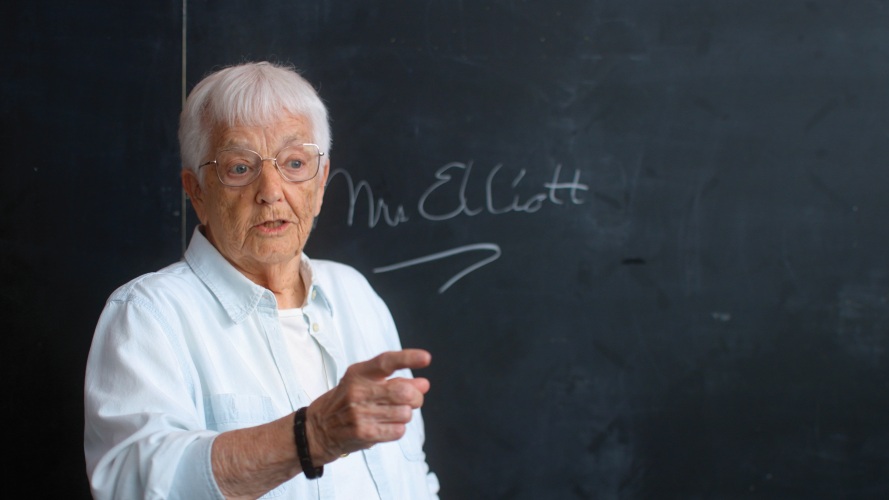
“Most people think of me as that miserable old bitch,” says educator Jane Elliot, but she is not bothered. Forceful and rigorously honest and direct, Elliott has a goal – to help people understand that racism and discrimination are not inherent, they are learned, and she will not let anything stand in her way. Judd Ehrlich’s documentary, Jane Elliott Against the World, catches up with Elliott as she approaches her 90th birthday, still actively traveling and lecturing. It’s a vivid and complex portrait of a fascinating individual, exploring different aspects of Elliott and her life. Her vigor and intensity are impressive – whether she is chopping down a cactus with a chainsaw or telling a roomful of teachers that they are cowards if they don’t speak out. The film follows Elliott, featuring contemporary interviews with Elliott, her daughters Sarah and Mary, former students, the rapper Killer Mike, and others, as well as archival footage.
In 1968, the day after Martin Luther King Jr. was assassinated, Elliott, a teacher in a small, all-white all-Christian community, felt that she had to convey the injustice of racism to her third-grade students. She conducted the Blue Eyes/Brown Eyes exercise for the first time, dividing the class arbitrarily according to their eye color, and teaching them that Brown Eyes were superior to Blue – more intelligent, more likely to succeed. The impact on the children was immediate, and the next day, she reversed the order. The students wrote essays about their experience, and one was published in the local newspaper. Elliott became famous, and infamous, for the exercise – one might well question the ethics of subjecting children to such an experiment. Over the years she expanded her work on racism and education for diversity, lecturing and conducting workshops at private corporations, government offices, colleges, and appearing on the Oprah Winfrey Show five times.
Almost 60 years after the first Blue Eyes/Brown Eyes exercise, there is enormous backlash against diversity education in the United States, gaining legitimacy from President Trump’s executive orders targeting DEI (diversity, equity, inclusion) programs. While Mary, who describes being Elliott’s daughter as “a joy and a nightmare” tries to get her mother to slow down, the film follows Elliott as she encourages teachers and students in Temecula, California as they contend with a conservative school board president.
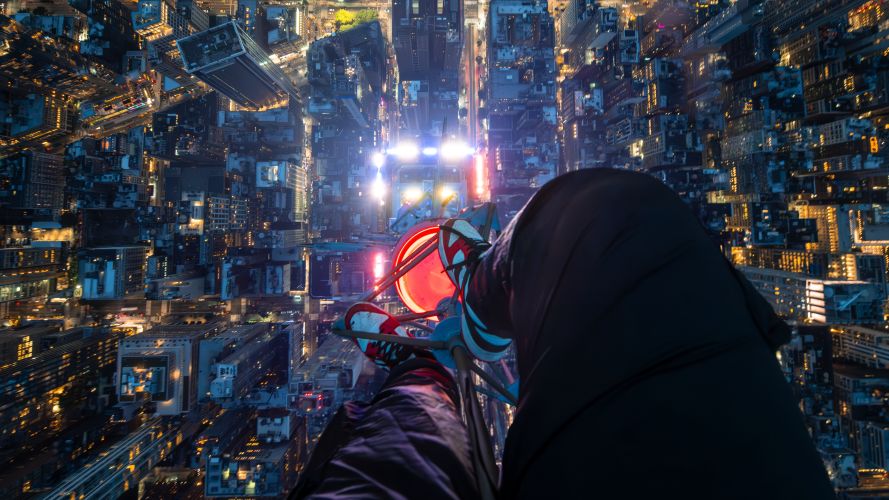
Drift opens with a dramatic scene of its protagonist, Isaac “Drift” Wright, climbing the dizzying height of Pine Tower (259 meters) in the New York City fog. The view is from his body cam, accompanied by his comments as he climbs, as well as voice-over narration explaining his perspective – looking at architecture and seeing “what could be created there in a space where people typically aren’t allowed to go.” The scene ends with images of Drift’s artwork; the photographs he takes once he’s reached the top. The images are stunning in their beauty, almost surreal, and terrifying when one considers the risks he takes to achieve his vision.
Directed by Deon Taylor, the documentary features breathtaking scenes of Drift’s climbs and his photographs, as well as an exploration of the artist and his art. Drift says he began by “wanting to know what it felt like in these different places.” For him, “the journey is as important as the photo” and he sees his work as “one big piece of performance art.” But as he describes his childhood, family, and military service, it becomes apparent that these climbs also provide healing for his spirit.
Drift’s path as an artist is not only unusual and dangerous, it is also illegal. Climbing the exterior of skyscrapers is technically trespassing. His encounters with law enforcement contribute to the action-adventure aspect of the film, while raising broader issues of racism and the dangers of being a Black man in the United States. Evoking the memory of George Floyd, Philando Castile, Alton Sterling, and Eric Garner, Drift said, “I was afraid of being another hashtag.”
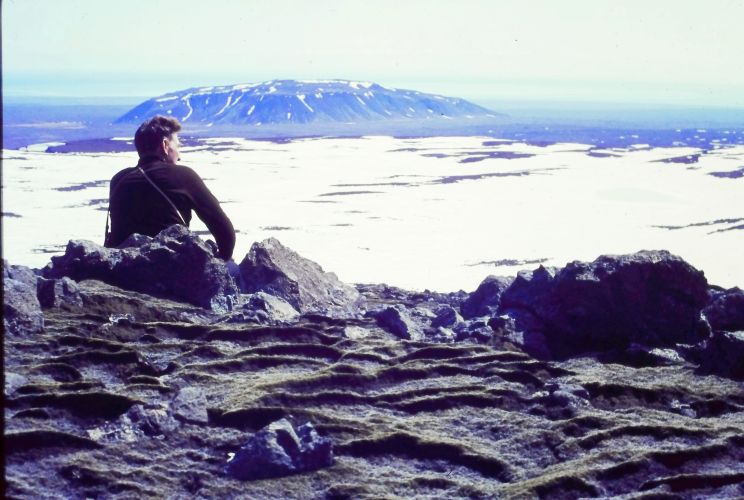
Time and Water, directed by Sara Dosa (Fire of Love 2022), is Andri Snær Magnason’s ode and elegy to Iceland, its glaciers and myths, and to his beloved grandparents. The Icelandic writer creates a time capsule to share with future generations, a poetic cinematic vision where science meets art, myth, and memory. For Magnason, the land and its geological history are intimately connected to his personal memories and family history, as he says, “my love for this place comes from those who raised me.” The film is composed of lively home movies, photographs, Icelandic legends and songs, weaving together the personal and the collective, love and loss, the changing earth and the imperative to preserve, protect, and remember.
Magnason’s grandfather, Árni, was one of the first to explore the glaciers. But climate change is a reality and the glaciers are melting. In 2014 the glacier Okjoköll was officially declared dead, and Magnason was commissioned to write the eulogy, thus becoming “the first to say goodbye to something we never thought we could lose.” As he contends with the loss of the glaciers and the inevitable loss of his grandparents as they grow older, approaching death, he searches for ways to keep them alive in memory, through documentation, and ponders a future that feels impossible to imagine. The film is a celebration of family and connection – to people and place, an evocation of our ability to move and connect through time, recalling the past and imagining the future. It is a call to recognize the reality of climate change, and it is a call to action.
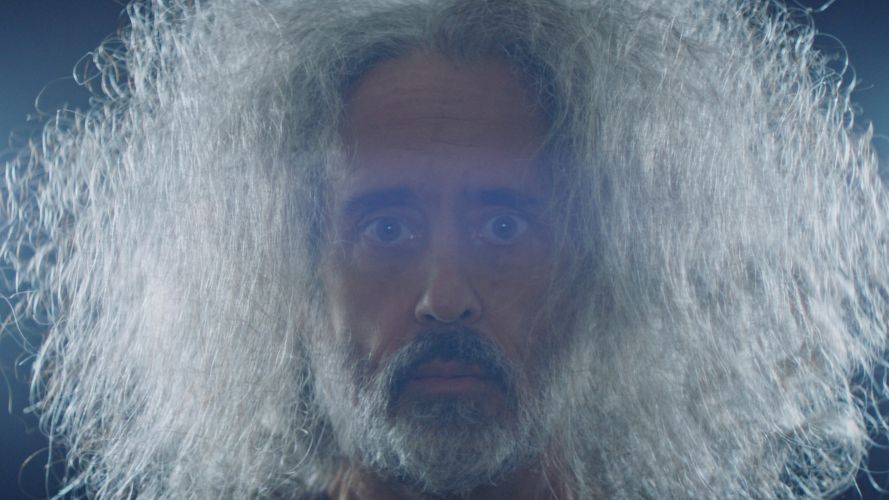
André is an Idiot, directed by Tony Benna, is a film that engages with family, death and memory and is, in its own way, a call to action. The film follows André Ricciardi over the course of three years following his diagnosis with stage IV colon cancer. André is an amazing character, funny, warm, creative, unpredictable, and outrageously open. He invites the viewer into his feelings, thoughts, family and home, as he faces what is inevitably a death sentence.
He calls not getting a colonoscopy at age 50 his biggest mistake, as colon cancer is treatable when discovered in its initial stages. Although it is too late to change his own fate, making the documentary is André’s way of helping others, letting his own mistake become a cautionary tale, encouraging and urging the public to get a colonoscopy. The film is surprisingly lively and upbeat for a film about a terminal illness, with medical procedures illustrated via Claymation style sequences. The experience of viewing is not at all grim, but rather engaging and full of life, full of the vivid character that is André.
Completing the picture, in more ways than one, is André’s family – his wife Janice and their two daughters. André dominates the screen with his larger-than-life personality, and it’s fun to spend time with him, and that’s the way he wants it saying “the more the cancer fucks me up, the funnier it should be, that’s victory.” But his family is where his heart is, and it is for and through them that his deeper feelings and fears are expressed.
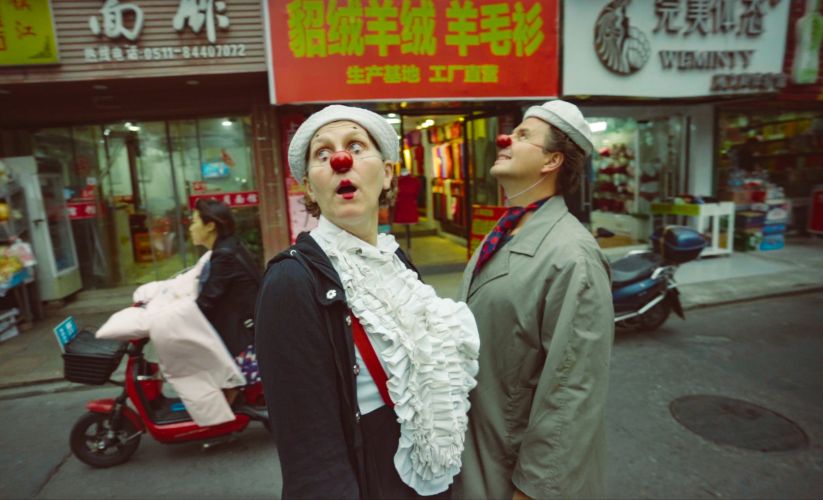
Family is at the core of two additional films that I recommend: My Family and Other Clowns, directed by Heilika Pikkov and Liina Särkinen, and Three’s a Company, directed by Naomi Baniel. The clowns referred to in the former are literal clowns. Haide Männamäe and Toomas Tross, partners in life and work, have a successful career in Estonia and abroad as the clown duo Piip and Tuut. But fame in theatre does not necessarily imply fortune or even financial security, and the two must perform and tour year-round to support their family – Emma, Siim and Anni, with whom they live in a modest two-bedroom house. The directors seem to have established a comfortable connection to the family as they filmed over the course of seven years, and the children grow and mature on camera. Emma and Anni are interviewed at different ages, speaking to the camera without their parents, they are at ease, and freely share their concerns. Haide and Toomas are well aware of the irony, as they perform a show intended for families to view together, while “we neglect our own family.” Although their profession is unique, their struggle to balance family and career is universally relatable.
In one of my favorite scenes, Haide and Toomas sit outside, rehearsing lines in a relaxed manner that to the external eye and ear might appear to be a casual conversation, then the film cuts to the same dialogue performed onstage. Scenes of Piip and Tuut in performance and on tour in China are juxtaposed with family scenes, illuminating the distance and difference between person and persona.
A very different family situation is depicted in Naomi Baniel’s Three’s a Company. The film focuses on Nava Zuckerman – a trailblazer on the Israeli fringe theatre scene, and her two partners Miki Zuckerman and Ilan Rosental. Co-founders of the iconic Tmuna Theatre in Tel Aviv, a thriving home for independent productions situated in a renovated garage, the film tells of their shared past through the frame of their current concerns. The municipality has promised them a new space for their theatre in a high-tech high rise, but the construction drags on for years while the building they work in falls further into ruin with leaking ceilings and worse. Even if the construction will be completed soon, will the new space have the feel of the original?
Yet although the intended move is fraught with difficulties and disagreements, their family life is unusual and unusually harmonious. They have been together, as a family unit, for about 50 years. Miki is Nava’s ex-husband, Ilan is her partner of many years, and together the three have raised their adopted daughter May, living next door to one another in the same building. They resolve the conflict between the demands of the theatre and the responsibility of raising a child in their own way, made perhaps somewhat easier by the fact that there are three adults caring for one child. The family dynamic is suffused with an appealing dry humor, and although like any family, there is the occasional friction, somehow it all works, perhaps because their unwritten law is, as Ilan says in the film’s opening scene, “Well, whatever Nava wants.”
Both men describe their involvement with theatre as entirely due to Nava, had she been drawn to a different field, they would have followed her there too. The film features many brief archival clips from works performed at Tmuna, as well as scenes of Nava at work in her capacity as director, that give a sense of her vision and creative force.
T
The 28th edition of Docaviv will take place from May 28 – June 6, 2026.
The full program of Docaviv is available on the festival website.