
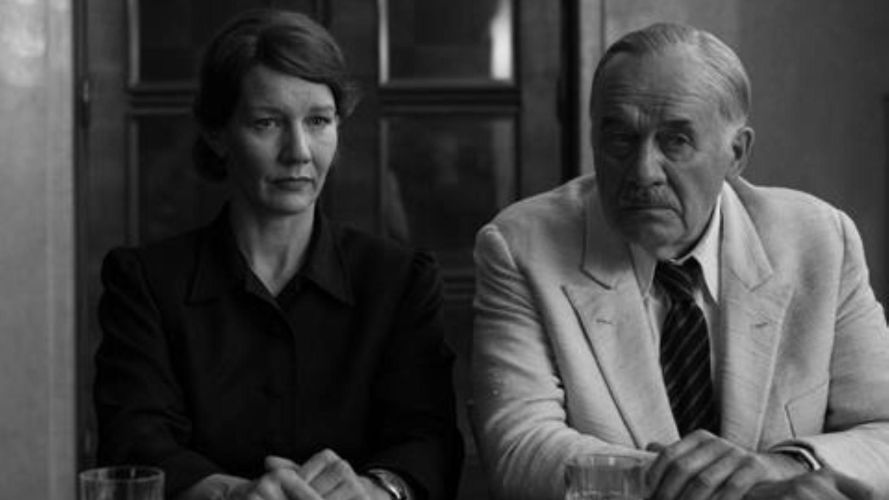
Set in 1949 and spanning just a few days in the lives of Nobel Laureate Thomas Mann and his children Erika and Klaus, Fatherland, directed by Paweł Pawlikowski (Ida, Cold War), with the luminous black and white cinematography of Łukasz Żal, distils an abundance of complex emotional, political, and historical themes into its tightly constructed 82 minutes run time. The film focuses on a real journey that Mann took to Germany to accept the Goethe Prize of the city of Frankfurt. Accompanied by his daughter Erika (Sandra Hüller), this trip marks the first time Mann (Hanns Zischler) visits Germany since leaving the country in 1933.
The film opening scene shows Klaus Mann (August Diehl) sitting naked on the floor, talking to his sister Erika on the phone, exuding cynical humor and despair, while over the course of the conversation his lover from the night before wakes up, hurriedly dresses and leaves without a word. These few brief moments convey a sense of the man and his lifestyle, as well as the strong bond between the siblings, as Erika urges him to join them on the journey.
Hüller delivers a piercing and nuanced portrayal of Erika, every slight shift of her gaze expressing volumes as she accompanies her father through press conferences and receptions. Her loathing for former husband and Nazi sympathizer Gustaf Gründgens, her marriage of convenience to British poet W. H. Auden, and war-time affair with fellow correspondent Betty Knox are all alluded in a meticulously edited scene that shifts from interludes of conversation to couples dancing as if they never heard of war to the stylings of a bouncy jazz singer (Joanna Kulig). Her devotion to her father is palpable, yet she is not afraid to be critical when criticism is called for.
Feted wherever he goes and fielding questions from journalists with intelligence and elegance, yet the inner turmoil is apparent. At the height of the Cold War, Mann was suspect in the United States as a possible Communist, should he make an official visit to East Germany, it could jeopardize his status in America. Believing in the ability of art to transcend politics, Mann the celebrated author presents an idealized vision of healing, but the intimate look at the man and father reveals his more fallible, human, aspects.
It’s a compelling, thought-provoking, film with strong performances, in which every frame is to be savored, that evokes the atmosphere of post-WWII Germany.
There will be additional screenings of Fatherland on Saturday, July 11th and Wednesday, July 15th. Tickets and additional information are available on the festival website.
Fatherland
Poland, Germany, Italy, France 2026 | 82 minutes | German, English, French, Russian | Hebrew, English subtitles