
The Haifa International Film Festival will take place from September 26 – October 3, 2026, with a rich and diverse program of international and Israeli films. I’ve had the opportunity to preview several international films – here are my recommendations:
Coward
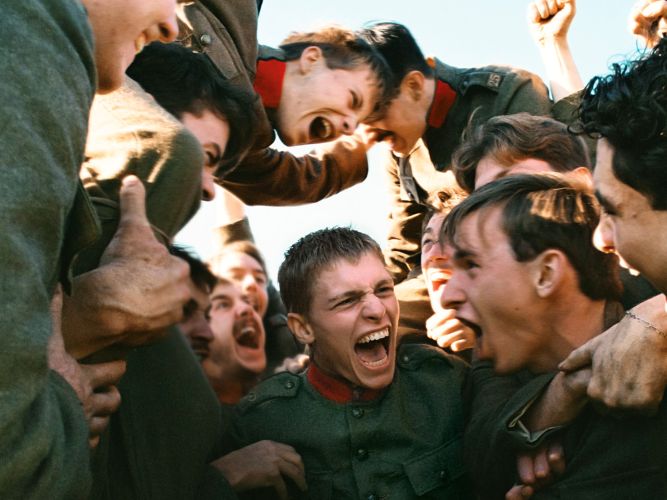
Lukas Dhont has explored queer themes – gender identity, internalized homophobia and the pressure to conform – with striking sensitivity, intelligence, and visual grace. Yet for me, both of his first two films, Girl (2018) and Close (2022), were marred by the extreme actions (self-harm, suicide) that undermined the otherwise delicate and detailed exploration of character and feelings. Coward, his third and strongest work, is set in the Belgian trenches of World War I, and the violence and brutality of war is the backdrop and ironic catalyst to a tender narrative and exploration of masculinity and courage. It is also Dhont’s most mature work in another sense – whereas the protagonist of Girl was 15 years old, and that of Close 13 years old, the protagonists of Coward – Pierre (Emmanuel Macchia) and Francis (Valentin Campagne) are adults, old enough to be soldiers. Macchia and Campagne shared the Best Actor Award at the 2026 Cannes Film Festival.
Pierre is a rookie, and one first sees him amid a crowd of soldiers on a train headed out to the front, as they all sing (in French) the 1915 song by George and Felix Powell – “Pack Up Your Troubles in Your Old Kit Bag and Smile, Smile, Smile.” It’s a brilliant opening move introducing the power of music and song as a community builder and ideological strategy to embed political and cultural values – a theme that will recur throughout the film, and it also has a more immediate visceral impact, for as the viewer watches Pierre smile and sing along with his cohorts, we know where they are heading.
Pierre is soon loading the bodies of dead soldiers onto carts and told: “Don’t think.” By comparison, the days spent hauling heavy artillery shells through the mud are painless. The film reflects the camaraderie and mutual support that develops under the harsh and stressful conditions, as well as the pressure to conform to a certain concept of masculinity. Pierre works in silence, his gaze and the set of his jaw reflecting the effort. His comrades give him the nickname “Quiet Mouse.”
Francis appears on the scene in flamboyant flair, acting out a woman in labor (on the dinner table) to cheer up (or tease?) one of their company whose wife gave birth to a son that he has not yet seen, and whom he fears he may never see. Bearing the scars of a wound, Francis is in his element as the actor/producer/director of shows to raise morale among the soldiers, his body language fluid and graceful, he radiates a sense of mischievous fun. A tailor by profession, he also creates elaborate costumes despite the paucity of materials. As there are no women at the front, the men take on female roles, which confers a certain freedom. The soldier’s amateur theatrics create a carnivalesque sense of a suspension of social norms amid the reality of war. Here, Francis can express himself as extravagantly as he wishes, and he is a delight to observe. In contrast, Pierre’s character is revealed more gradually, through his relationships with his fellow soldiers and his responses to what is happening.
Initially indifferent and rather reluctant, Pierre is persuaded to help build a stage for the theatre group and gradually becomes more involved. Francis is unabashedly flirtatious, which is in this context socially acceptable, as it’s all just for fun. As their relationship deepens, and the realities of war become ever more glaring and beyond bearing, the differences between the two emerge as well, despite their mutual attraction.
The performance sequences, at first funny and flirtatious, reflect the ability of art to transcend reality and provide a temporary escape. As the film progresses, musical interludes are employed to underscore the fears and loneliness of the soldiers, the power imbalance between soldiers and officers, and the painful devastation of war.
Tangles
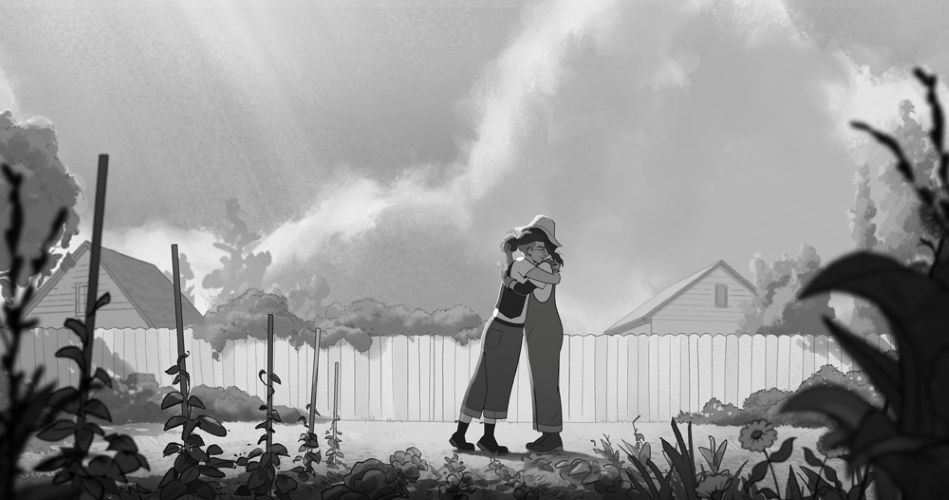
Directed by Leah Nelson, with a screenplay by Nelson, Sarah Leavitt, and Trev Renney, based on Leavitt’s graphic novel Tangles: A Story About Alzheimer’s, My Mother, and Me (2010), is a beautifully crafted, moving 2D animated film suffused with humor and compassion that follows Sarah and her family as they cope with her mother’s Alzheimer’s disease. The film’s art differs from Leavitt’s graphic novel, but art director Manddy Wyckens evokes a similar sense of energy and spontaneity in primarily monochrome with occasional small bursts of color. The narrative of the film is faithful to the memoir, with one major change – the location. Instead of taking place in Vancouver, Leavitt’s home, the parents live in Maine, while twenty-something Sarah lives in San Francisco. The excellent voice cast features Abbi Jacobson, Julia Louis-Dreyfus, Bryan Cranston, Beanie Feldstein, Samira Wiley, Seth Rogen, Bowen Yang, Sarah Silverman, Wanda Sykes, and Pamela Adlon.
An artist and activist, Sarah (Abbi Jacobson) works as a receptionist at Outspoken, an LGBTQ+ magazine. The year is 1999. The editor asks her to do some illustrations of “hot women’s sex” for the magazine, and while putting up posters for a rally against police violence, she meets the intriguing Donimo (Samira Wiley), and it seems like everything is going well in love and work. But on a visit home to her mother, Midge (Julia Louis-Dreyfus), and father, Rob (Bryan Cranston), her sister Hannah (Beanie Feldstein) tells her that Midge has been fired from her teaching job. Sarah notices that her mother has left an iron on burning through a shirt, and when asked about it, Midge responds in an irritable and moody manner. Feeling that her mother is not her usual self, Sarah suggests consulting a doctor, but her parents both insist the mood swings are just a natural part of menopause.
Sarah and her family’s journey stretches out over several years, as Sarah travels back and forth from San Francisco to Maine, punctuated by hilarious commentary in the style of airline announcements that reflect Sarah’s anxieties. The freedom of animation lets the narrative move fluidly between scenes that document events and conversations, and those that depict dreams, fantasies, and emotions. The film depicts the family’s response to Midge’s decline with aching precision, from the initial denial to the despair of the diagnosis, the differences of opinion on how best to care for Midge. The film opens with an acknowledgement that this is Sarah’s personal memory of those years, while other family members may “remember differently.” Tangles depicts the impact of Alzheimer on Midge and her entire family, and the changes they all go through. Especially poignant is the relationship between the two sisters, the tension between them as each struggles with her own situation – Hannah living close to their parents and experiencing Midge’s deteriorating capabilities daily, and Sarah, flying in for visits, trying to maintain the life she has built in San Francisco while caring for her mother and cherishing all the small moments that might be “the last time” – and the understanding, empathy, and support.
A powerful opening scene sets the tone as a young Sarah sits up in bed, afraid of the monsters in the wallpaper. Midge, whose first instinct is to reassure her that there are no monsters, pivots to validating Sarah’s feelings and fights the monsters with her flashlight, vanquishing them. As her mother, the powerful hero, loses memory and abilities, and the roles are reversed, the adult child becoming the caretaker, love, loss, and sorrow merge.
Flies
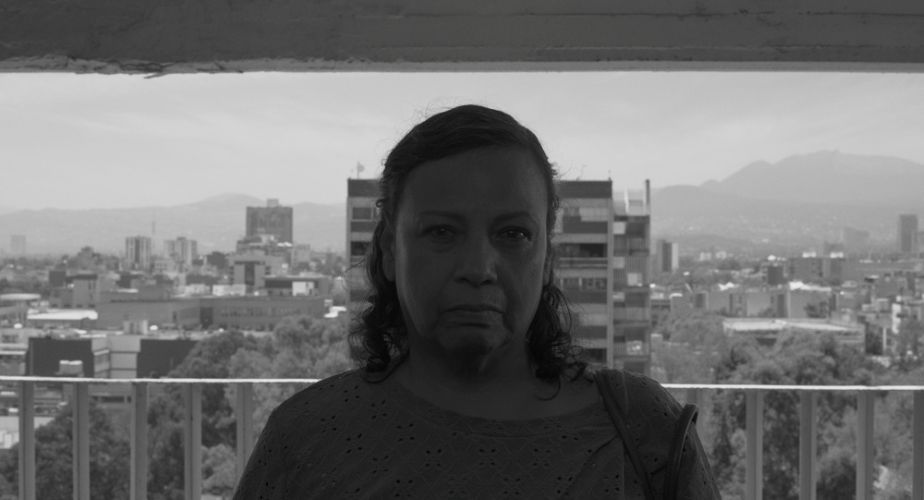
Flies, directed by Fernando Eimbcke, moves at a careful pace at first, as its strong visual storytelling adds layers of texture, establishing its main characters. Olga is a middle-aged woman leading a solitary, narrow life. When the neighbors are noisy, she shuts out the sounds of life with earplugs. Financial necessity forces her to rent out a room in her apartment, but here too, she defines her boundaries very strictly: no kitchen privileges. Tulio (Hugo Ramírez) has no alternative but to accept her conditions as wants to be near his wife who is in the hospital. What he does not reveal to his new landlady is that his young son, Cristian (Bastian Escobar) will be staying with him. Tulio’s tender care for Cristian, his warmth, is in sharp contrast to Olga’s rigidity. The tempo shifts as the film follows Cristian, who has two main goals – visiting his mother at the hospital (children are not allowed) and getting the precious coins needed to play the arcade game Cosmic Defenders.
It’s a premise that could easily slide into predictable sentimentality – contrasting characters brought together by circumstance: older, lonely woman and charismatic youngster. But Eimbcke’s characters are so well-grounded their actions and emotions always feel authentic, and the narrative never reaches for idyllic resolutions, offering instead a more complex and difficult reality sparked by moments of compassion and joy. Escobar imbues Cristian with a wonderful energy and spontaneity as each passing day becomes an adventure. Teresita Sánchez delivers a terrific performance as Olga. When this fortress of a woman, locked within her own defences, reveals something of her inner self, it’s a surprise worth waiting for.
Truly Naked
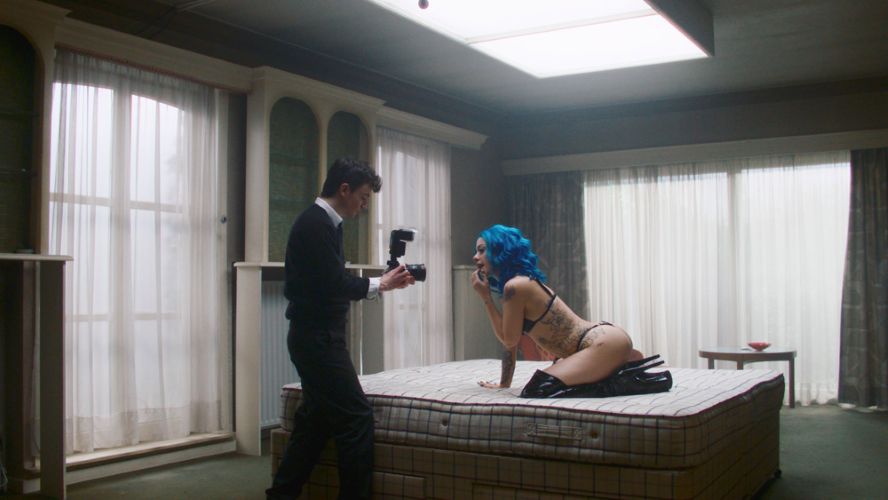
Truly Naked, directed by Dutch filmmaker Muriel d’Ansembourg looks at pornography from an intriguing perspective and explores issues of intimacy and relationships. The film was shot in English, in the U.K., and Myrthe Mosterman’s cinematography captures the nuances of emotion and the seduction of staged images, as well as the rough natural beauty of the coast.
Alec (Caolán O’Gorman) and Nina (Safiya Benaddi) have been assigned to work together on a school project – internet porn addiction. They can’t work at Nina’s house because it’s being renovated, and Alec tells her his place is not an option because his dad works at home, explaining, “My dad doesn’t like having people around when he’s working.” That’s because dad Dylan (Andrew Howard) makes porn movies at home, in which he also performs. The film takes a non-judgmental look at Alec’s life as he navigates the typical coming-of-age issues in these unusual circumstances. d’Ansembourg worked with an intimacy coordinator, Philine Janssens, on the film, which I applaud.
Alec lives between two worlds, and Caolán O’Gorman delivers a sensitive performance that reveals the complexity of Alec’s character. At home he is an integral part of their father and son cottage filmmaking production, wielding a camera like a pro and utterly at ease. Their small family moved to a coastal town two weeks ago, so it’s not too surprising that as a newcomer Alec seems rather quiet and diffident at school. As he tries to fit in and make some friends, he emphatically does not want anyone to know his father’s profession. Although he has a friendly, close relationship with Lizzie (Alessa Savage), one of the main actors in his dad’s films, when she calls for him at school, he is furious and embarrassed. Alessa Savage, who is an adult film star, imbues the character of Lizzie with vitality, authenticity, and complexity. When Alec distances himself, she pushes back, saying, “Don’t try and shame me, it took me a long time to be comfortable with who I am and what I do.”
There is an immediate spark between Alec and the confident, assertive, Nina, who hands Alec a helmet and takes him on her motorcycle to her “woman cave” on the shore where they begin to discuss their school project. Aside from a thought-provoking conversation on the ways women are referred to in pornography (bitch, slut, and many more in a similar vein) as opposed to men (big daddy), the focus of the film shifts from the project to the relationship between Alec and Nina.
Through Alec’s experiences it seems that although he knows a lot about sexy camera angles, and has seen many sexual acts, but that has not educated him or prepared him for intimacy or a relationship. Although there is a warm, collegial friendship between Lizzie and Dylan, it is also made clear that the porn industry is transactional and profit driven. In addition to strong performances by the entire cast, the film raises critical questions, among them – how do you set boundaries in a field that constantly has to do more, break more boundaries to hold its audience’s interest?
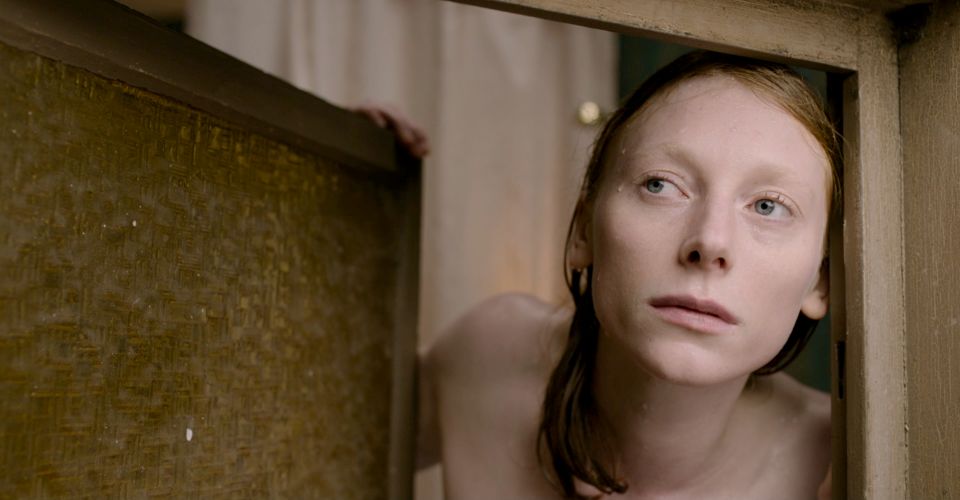
Easy Girl (Smalltown Girl)
Moving freely between past and present, reality and memory, Hille Norden’s feature Easy Girl takes on difficult themes of sexuality, abuse, trauma, and healing. The emotional impact of the film is profound, but the film is careful never to be exploitive, and the most disturbing scene takes place beyond the frame, off camera. In contrast to the painful issues it raises, the film’s visually appealing design, creative storytelling, and strong performances keep it buoyant and bright.
At first glance Nore (Dana Herfurth), a vision in lavender tulle, appears free, bold, and in control. She is at a bar, looking for a man with whom to spend the night, and gazing at her is Jonna (Luna Jordan, who died recently at age 25), a medical student and former classmate of Nore’s. More reserved and less socially adept, Jonna admires Nore’s easy sexuality and invites Nore to come home with her. As it turns out, Nore remembers Jonna from school, and the past was not so harmonious. Nore had a reputation for being “easy” and Jonna, at the time, was not a fan, but rather went with the crowd, joining in the rumor mill.
Nonetheless, when Jonna invites Nore to move in with her, Nore agrees, and the two develop an affectionate and supportive friendship. A talented seamstress, Nore makes her own clothes, colorful and fanciful. She changes sex partners as often as she changes outfits, and Jonna aspires to emulate her casual approach to sex and sophisticated approach to fashion. Yet there are signs that Nore’s nonchalant appearance is a defence created to cover a deep, long hidden trauma.
As Jonna begins to question Nore’s choices, their conversations awaken Nore’s memories. Given Nore’s past, her close friendship with Jonna is perhaps the first she has experienced, a safe harbor that helps give her the courage and support to explore the deep waters of the past. Norden conveys the complexity of memory and trauma, as Nore’s memories play out in scenes with the actor Vera Fay portraying the young Nore, emphasizing her youth and vulnerability. The older Nore, in her mid-twenties, is literally a different person than the young Nore, and yet her identity has been shaped by the experiences of her youth.
In the conversation on consent, what does it mean when a 14-year-old girl says “yes” to a man in his twenties? A man who has told her what every girl (everyone?) wants to hear – that she is special, an exception. The film makes it clear, in an emotionally visceral way, that the power imbalance makes consent impossible.
The full program and ticket information are available on the Haifa Film Festival website: https://www.haifaff.co.il/eng.