
The Arava International Film Festival will take place from November 4 – 14, 2026. I’ve had the opportunity to preview four of the films that will hold their Israeli premiere at the festival – I recommend them all!
Atonement

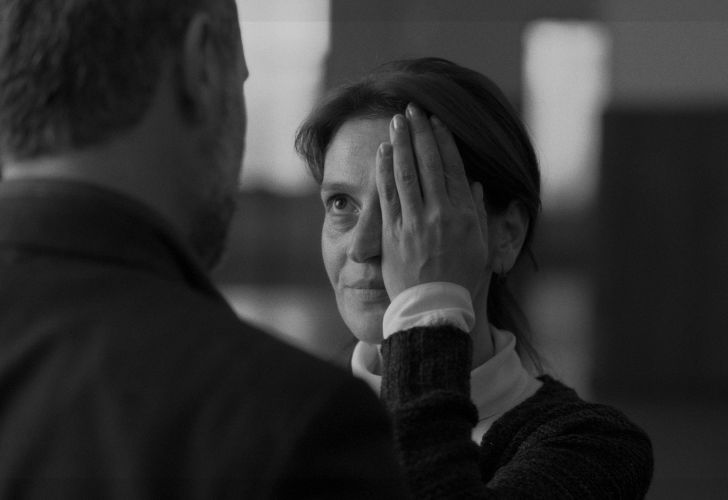
Atonement, written and directed by Reed Van Dyk in his feature debut, is a striking film that conveys the ravages of war in a thought-provoking manner. Based on a 2012 article in the New Yorker by Dexter Filkins, the film looks at a tragic incident in the Iraq War, and its aftermath, through three different perspectives. Moving performances anchor a strong commentary on the impact of war, especially that of Hiam Abbass as Mariam Khachaturian, whose visage expresses a depth of pain and understanding that reaches beyond words.
The film finds the Khachaturian family, in Iraq of 2003 – Mariam, her husband, their three children, and eldest son’s wife and baby, staying with her sister, because their own home is close to the police compound, a military target. Other than mild annoyances, like no running water, it’s an ordinary day. But when there is an explosion nearby, they begin to feel less safe and decide to return home. The ensuing scene conveys all the chaos and confusion of war – for the soldiers, as well as civilians.
Once the shooting has stopped, Michael Reid (Kenneth Branagh), a reporter for the New York Times, comes to the hospital where a doctor tells him of a tragic case that has just come in. After talking to Mariam, Reid decides to interview the squad of Marines who were shooting from a rooftop. One of them is Lou D’Allesandro (Boyd Holbrook).
The film catches up with Lou ten years later, dealing with PTSD and trying to get his life on track. Haunted by the deaths of civilians, he is determined to meet in person with the remaining members of the Khachaturian family, who are now living in the U.S. and would like Reid to arrange the meeting. Does he want to apologize, does he want to be forgiven? What comes across very clearly in the film, is something Lou’s wife Anna (Gratiela Brancus) says: “When you pick up a gun and shoot, the bullet moves both ways.”
Everytime

Winner of the Un Certain Regard award at the 2026 Cannes Film Festival, Everytime, written and directed by Sandra Wollner, is a feat of filmmaking that examines grief and guilt from an intriguing perspective.
Ella (Brigit Minichmayr), a hard-working single mother is planning a vacation with her two daughters – 17-year-old Jessie (Carla Hüttermann) and the much younger Melli (Lotte Shirin Keiling). The girls share a room in their small Berlin apartment, which inevitably leads to the kind of bickering typical to sisters, especially when there’s an age gap. They are planning to go to Tenerife, where Jessie has been before as a toddler, when their father was still in the picture. They need to pack in anticipation of an early start the next morning, but late at night, Jessie sneaks out to meet her boyfriend Lux (Tristán López) for a last night out clubbing. A night that ends tragically.
The film cuts to Ella tending Jessie’s grave, while donning headphones and dealing with a work call. Some time has passed, and Lux is back, having been out of the country. When Ella and Melli run into him, Melli runs to hug him, and the three begin to spend some time together. All three grieve the same person, yet they each are very alone in their grief. For Melli, her phone has become a precious object, and she continues to text Jessie. Jessie is gone, but she is also still very present – not just in their thoughts, but in photographs, home movies, texts, and voice messages.
It is in its third act that the film takes a turn into the surreal that defies interpretation. Ella spontaneously decides to take Melli and Lux to the resort in Tenerife, to remember Jessie with the vacation that never happened. What takes place there – dream, hallucination, crazy trip or fantastic break with reality – defies logic yet is always gripping and emotionally compelling.
I’ll Be Gone in June

In her keenly observed debut feature I’ll Be Gone in June, Katharina Rivilis captures the experience of being an outsider, through the perceptive gaze of Franny, a German exchange student who spends a year in Las Cruces, New Mexico. Naomi Cosma is luminous as Franny, her eyes reflecting the myriad emotions of a sensitive, curious, and independent young woman, who is not afraid to be vulnerable. Set in 2001, the film is also a portrait of America in the immediate aftermath of 9/11. Visually compelling and with an eclectic and precise soundtrack, augmented by a strong cast in which even those with brief cameos are affecting and contribute a sense of authenticity, it’s a sensitive and powerful coming-of-age film.
The red hues of mountain terrain look almost like an alien landscape as Franny’s plane lands at the small airstrip in Las Cruces. Having spent a few days in New York, by comparison, the small town where she’ll be spending the school year seems strange and disappointing. When she asks her host family’s teenage daughter Robin what kids do for fun, the answer – which will be familiar to any small-town American – is “Friday night football” and “driving around.” Registering for classes at the high school, she is introduced to the local conservative mores as the counsellor informs her that her cropped sweater is inappropriate, saying, “We can’t be showing our bellies.”
The film shows Las Cruces, its people and places through Franny’s eyes literally as well, incorporating footage from her camcorder as she documents her experiences. While respectful of her new surroundings, Franny is never hesitant to express her own opinions. When after 9/11 the father takes the girls to practice shooting a rifle – in case of a terrorist attack – she comments: “terrorists must be so bored here.” Yet the difference in their world views is always a presence. Franny is almost never without a book – Kleist and J. D. Salinger among others, a pastime that everyone else appears to find somewhat odd, if not a waste of time. Franny has dreams and plans for her future, she wants to study literature and is hoping for a scholarship to Yale, in Las Cruces she encounters fellow students for whom the only hope for a college education is to join the military, and others who don’t even dare dream, because, “Once you’re here you can’t get out.” She is also confronted by instinctive bigotry on a personal level, as one student calls her “the Nazi girl” and on a larger scale, the heightened post-9/11 wariness of foreigners.
In time, the stark, rugged, landscape reveals its own beauty, and Franny begins to meet people with whom she connects. They too are outsiders in their own community: Sam (Bianca Dumais), who has been stigmatized as a “slut” and the brooding, elusive Elliott (David Flores), who is interested in music and art. Come June, as the title promises, this interlude must end, yet there is a strong sense that it will leave an indelible mark on Franny and on her friends as well.
Guria
Levan Koguashvili’s Guria is suffused with wry humor, compassion, vivid characters, and a wonderful soundtrack of Gurian harmonic singing. Set in the early 90s, in the post-Soviet era, it follows the adventures and misadventures of Zuriko (Kakhaber Tcholadze) and his best friend Gela (Vamekh Jangidze) in a small village in Guria, a region in western Georgia, bordered by the Black Sea on the west.
The local economy is suffering but there’s still much to sing about. A car rolls slowly along the street, announcing the upcoming Miss Guria 1992 competition, with the grand prize of a food processor, and its instruction manual. Wait for the competition itself – it’s hilarious (and disturbing). But for Zuriko, a farmer, the lower prices on hazelnuts are a far greater concern, especially since he is already in debt. Gela has other matters on his mind, playing matchmaker to his widowed friend, he brings the stylish Irma (Eka Sharikhadze) to town, with her swinging ponytail and oversize sunglasses. But an offer to sell his hazelnuts to a different buyer out of town sets Zuriko and Gela off with the hazelnuts in Gela’s truck, first stopping to drop Irma off with Zuriko’s mother-in-law Veriko (Tamia Kalandadze).
At the same time, there is a military drill at the high school, where Zuriko’s son Achi (Sergi Kviloria) vies with bad boy Beso (Davit Natsvaladze) for the attentions of Eka (Anamaria Kamladze), a local young beauty. It’s a very small village and the characters’ narrative arcs connect and cross paths in darkly amusing ways. The celebration of traditional Gurian singing, known for its energetic three-part harmonies is one of the film’s great pleasures. But Koguashvili also shows the viewer the less delightful aspects of village life, such as the oppressed status of women, and the endurance of traditions like “bride kidnapping.”
Information on the festival and local accommodations may be found on the festival website: www.aravaff.co.il