
There’s still time to see these films at the Haifa International Film Festival:
All the Lovers in the Night
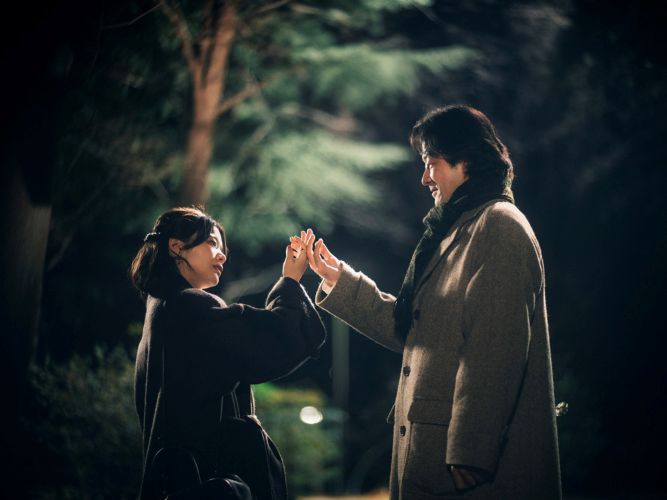
Graceful and restrained, Yukiko Sode’s All the Lovers in the Night, based on the eponymous novel by Mieko Kawakami, reveals itself slowly as it follows its reticent protagonist Fuyuko (Yukino Kishii), a freelance proofreader who leads a quiet life in Tokyo. Finding wonder in small moments, as when Fuyuko takes up a pencil sharpened to a precise point, marking the errors in a manuscript with delicate lines. An intriguing aspect of the film is the intermittent narration of Fuyuko’s inner thoughts by a male voice (Tori Matsuzaka), which opens with a poetic meditation on the beauty of the night. The film is also sparked with subtle humor, as when a group of proofreaders hang out together at a restaurant, the conversation reflecting their very niche perspective.
Kishii delivers a powerful performance as Fuyuko, conveying as much with her gaze and body language as she does in words, which she uses sparingly. Fuyuko has one friend, the boisterous, extroverted Hijiri (Misato Morita) who insists on drawing her out of her shell. Morita brings a comic energy as a foil to Fuyuko’s almost silent presence, yet their relationship is more complex than what is immediately apparent. Sitting together at a bar, Hijiri asks Fuyuko what she does when she’s not working, but Fuyuko doesn’t appear to have a life beyond proofreading. Yet there is a strong sense that she has a desire for more.
Chance leads to an encounter with Mitsutsuka (Tadanobu Asano), a slightly older physics teacher who is almost as reserved as Fuyuko. She assumes agency in moving the relationship forward – perhaps the first time she has done so. It’s a small move, so small it might pass unnoticed – she suggests that they exchange contact information. The two begin to meet regularly at a coffee shop, talking about physics and light. There is a sense of wonder in Fuyuko’s musings on light, and a warmth in Mitsutsuka’s responses that infuses the film with radiance.
One gradually learns more about Fuyuko, her issues, her struggles, her desires, and something of her past, yet much remains sealed. The narrative does not follow a predictable path, and that is much of its allure. Instead, there are meandering paths, and luminous moments.
Next Screening: Tuesday, September 29th
Sundays
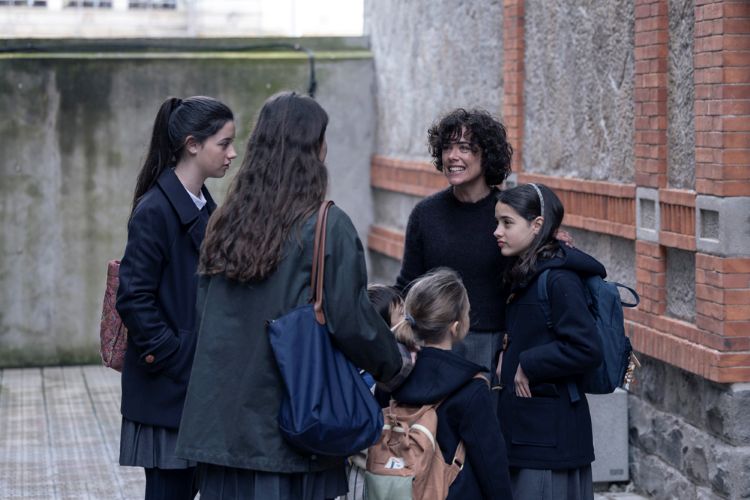
Written and directed by Alaúda Ruiz de Azúa, Sundays is a compelling film that explores belief, family relationships, and cultural norms. 17-year-old Ainara (Blanca Soroa) returns from a retreat with her class at the Betinas convent, with a desire to return for a longer stay to explore the possibility of becoming a nun. Although her family is Catholic – Ainara attends a Catholic school – there is a sense that for some family members attending church is more of a social norm as opposed to stemming from inner faith. Ainara’s father Iñaki (Miguel Garcés) cannot comprehend why she would want to do such a thing and refuses to give his permission. So Ainara turns to her aunt, Maite (Patricia López Arnaiz). While Iñaki appears to be more of a pragmatist, his sister Maite believes just as intensely that God does not exist, as Ainara believes that he does.
The intersection between complex family dynamics and differences of belief is at the heart of the film. Ainara’s mother is dead, and her father has a new girlfriend, Estíbaliz (Leire Zuazua), raising the possibility that Ainara seeks the assurance of God’s love to fill the void left by her mother’s death. She is also still a teenage girl who has crushes on boys and on the bus home from the retreat, listens and sings along with her friend Izaskun (María Rodríguez Maribona Delgado) to a song with the lyrics: “she’s quiet but sexually bold.”
Blanca Soroa delivers an outstanding performance, conveying the depth of faith and conviction that coexists along with the turbulent feelings of youth, as well as the moments of excitement and pleasure. When she seeks out Maite’s help to convince her father, confessing her desire to take the first step in her “discernment” – the process of learning what God asks of her, her aunt is clearly shocked and attempts to be supportive, while trying to gently sway her niece. Patricia López Arnaiz portrays the complex character of Maite, as she struggles with her personal problems – the growing distance from her husband and anger at Iñaki over financial issues, while desperately trying to save her niece from what she believes would be a tragic mistake.
Next screening: Wednesday, September 30th
INK

In INK, director Danny Boyle (Trainspotting, Slumdog Millionaire) brings his signature energy – along with the talented creative team of James Graham (screenplay), Alwin H. Küchler (cinematography) and Fin Oates (editing) – to the exciting story of Rupert Murdoch’s acquisition of The Sun in 1969, and his often-fiery relationship with its editor Larry Lamb, as the latter steers the tabloid’s rise in popularity. Jack O’Connell imbues Lamb’s character with the drive of a self-made man, as he confronts Murdoch (an impressive Guy Pearce) time and again. The opening scene at Rules restaurant, as Murdoch tries (and succeeds) in wooing Lamb away from his job at the Daily Mirror, is dazzling with its slanted camera angles, sharp cuts and fleeting shifts to other scenes, and images that extend beyond the frame, setting the frenetic tone for the film, and embodying the sensationalist feel of a tabloid. It’s a fast-paced, riveting look at journalism and media, raising ethical questions along the way.
Next screening: Saturday, October 3rd