TLVFEST opens October 22, 2026, with a diverse array of films – here’s my take on the films I’ve had the opportunity to see in advance.
Rose
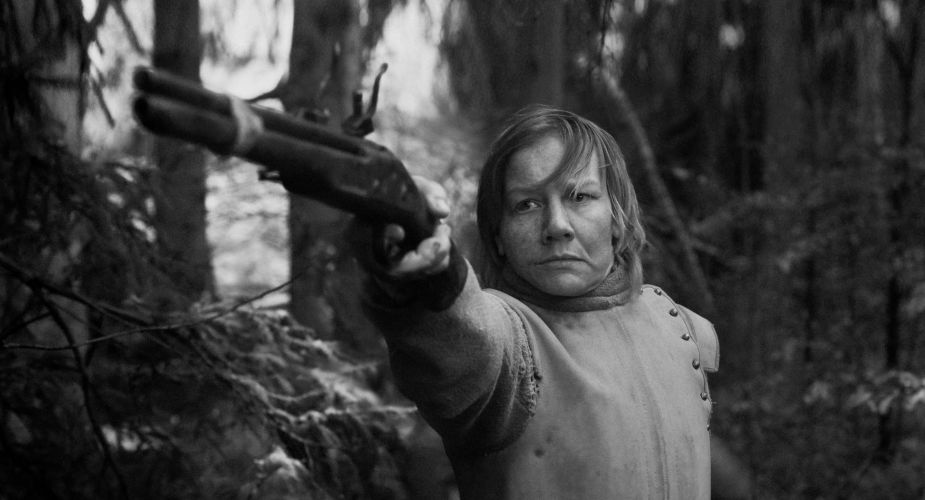
Rose is a magnificently crafted work of art with a powerful performance by Sandra Hüller. Directed by Markus Schleinzer, with a screenplay co-written with Alexander Brom, the monochrome film is set in the 17th century Germany at the end of the Thirty Years War. A soldier (Hüller), scarred and battle-weary, arrives in a small, religious, farming community to claim an inheritance – a plot of land that has long stood empty. The villagers are suspicious of the stranger, but with the documents and the correct answers to prove his identity, they reluctantly accept the soldier as the owner of the property.
Historically, there have been women who have passed as men to gain access to equal rights in education, careers, military service, and freedom of movement. The film reflects the privileges accorded to men and the power they held in the community, as opposed to the restricted lives and oppression of women, who were regarded more as commodities, owned by fathers and husbands, than individuals. For Rose, passing as a man enabled her to create an independent life, first as a soldier, then as a farmer. But that freedom comes at a cost. To maintain the façade, she must be ever-vigilant, never vulnerable, destined to be a loner. As the film’s narrator (Marisa Growaldt) says, “What is life in deception and lies, can it be called freedom?”
Wearing the bullet that slashed her face on a string around her neck, the former soldier is a man of few words, who soon proves his worth by killing a bear that endangered the village, and establishing a reputation as an ambitious hard worker. Hüller delivers an exceptional performance that reveals the fear and uncertainty, as well as the intelligence, resourcefulness and courage, beneath the stoic demeanor with which the protagonist faces the world. Framed by narration, evocative cinematography, and accompanied by a hauntingly beautiful vocal score by Tara Nome Doyle, there is a folktale feel to the film, a sense that it seeks to convey a moral lesson, yet one that differs from that which is explicitly stated, just as with Rose, what is hidden differs from that which is revealed.
A Man Walks Down the Street
Written and directed by Yuval Hadadi, A Man Walks Down the Street is a reflective film that follows Raanan (Angel Bonanni) as he contends with the past choices that have shaped his life. Living and working in Holland as a teacher of architecture for the past 30 years, Raanan comes back to Israel to clear out his late mother’s apartment which has been sold. Back in his old neighborhood, Raanan sees someone he recognizes, a sight that sparks a flood of memories as the film merges his experiences in the present with flashbacks from the past.
52-year-old Raanan is a handsome, rather reserved man, who catches the eye of the charming young Adir (Yotam Rotshtain), who he’s hired to haul away an old couch. Adir’s open approach to life, his candor and comfort in his own skin and nail polish are a sharp contrast to Raanan’s restraint. The young Raanan (Gili Blum), as seen in flashbacks, is energetic and excited about life, and on the cusp of life’s big decisions, but he is also very conflicted. He loves to draw yet is worried that studying art will not work out as a career. He is attracted to men, but is deep in the closet, complete with a girlfriend Michal (Ashley Zimberg Tao), who does not know (or has difficulty acknowledging?) that there is an issue.
As one follows Raanan through the journey into his past, the narrative of a significant relationship with a man called Itzik (Itzik Saydof) emerges, in parallel to the present-day development of a casual relationship with the very appealing Adir. Adir’s confidence and freedom accentuate Raanan’s emotional withholding, fears, and internalized homophobia. His presence, and the appearance of an elderly man walking down the street, inspire Raanan’s introspection as he reflects on the choices he has made. A poignant and moving film that reverberates in the mind long after the credits roll.
Bookends
Nate Glass, the protagonist of Bookends, is living the ideal New York City life. He’s writing a novel, living with his handsome Swiss boyfriend in a great apartment, learning German at lunchtime, and going to spin classes with his best friend Sarah. But most of that is an illusion. After two years, he’s still just working on the outline of his novel, and his boyfriend – who pays for the apartment and the big city life – is getting fed up. A painful breakup leaves Nate with nowhere to go, and for lack of an alternative, he moves in with his grandparents who live in a Jewish retirement community.
Directed by Mike Doyle and with a screenplay by Noam Ash – who also stars as Nate – Bookends is heart-warming and funny. Nate is feeling all the feels and expressing them loud and long. His grandparents – wonderful performances by F. Murray Abraham as Saul and Caroline Aaron as Miriam – embrace him whole-heartedly but are also eager to provide him with the benefit of their advice. It’s not too late to go to business school.
Stuck in this “sad little town” Nate stumbles around dealing with his sorrow and anger, but conversations with his grandparents soon turn his attention outward. Saul, a Holocaust survivor, veteran of the Korean war, and college textbook writer, is showing some disturbing signs of confusion and memory loss. But when Nate brings it up, Miriam denies that there is anything wrong. She is eager to get her grandson back on track in love and work and challenges him to write ten pages a day. She’s also managed to find “another homosexual” to introduce to Nate.
Bookends is a coming-of-age film for late bloomers, that celebrates family, love, and friendship. Noam Ash brings an endearing vulnerability, vivacity, and humor to his portrayal of Nate, and Charlie Barnett as the potential love interest is devastatingly handsome.
The Captive
Alejandro Amenábar (Open Your Eyes 1997, The Others 2001, The Sea Inside 2004) takes the viewer to Algiers of 1575. Merging biographical details from the life of Miguel Cervantes, author of Don Quixote, with homoerotic speculation, The Captive is an adventure film that reflects on issues of power, and the power of story. The known facts are that Cervantes served in the Navy, where he was wounded at the Battle of Lepanto and lost the use of his left arm. He was captured by Barbary corsairs and held in Algiers for five years before being ransomed by a religious order and released. Dr. Antonio de Sosa (1538-1587), a Spanish priest who was also held in Algiers, became the first biographer of Cervantes.
The film follows Cervantes during his years of captivity, with a lot of creative freedom, including a brief, yet delightful, imaginative visual foreshadowing of Don Quixote. As he and his fellow captives wait in the hope that they will be ransomed, Cervantes (Julio Pena Hernandez) enthralls them with stories. His voice carries to the window of the Bey, Algiers regent Hassan Baja (Alessandro Borghi) who summons the prisoner to his quarters, and a complex relationship develops. The film moves between the narrative of Cervantes’ experiences and the narrative of the stories he tells. Lots of good-looking men, erotic tension, scheming and adventures.