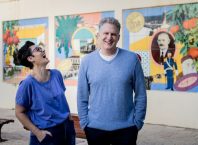
Tmuna Theatre has always been a home for independent, cutting-edge theatre and emerging new voices. During the current festival I enjoyed four short works by young creators, recent graduates of The Goodman Acting School of the Negev, The Performing Arts Studio Founded by Yoram Loewenstein, Nissan Nativ Acting Studio, and Bezalel Academy of Art and Design Jerusalem.
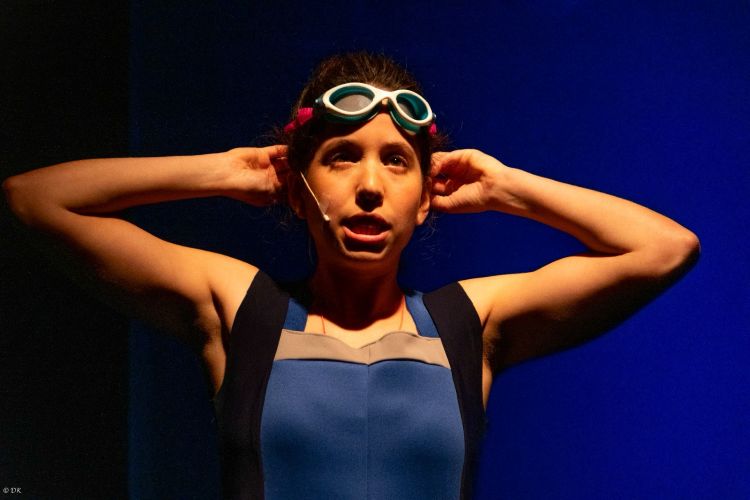
First on the program was a very personal work by Lyri Yadin, a graduate of the Nissan Nativ Acting Studio. Performing with Lyri were actors/creators Gali Hagilady, Matan Salem, and Lia Covo Kadosh. In a work that deals with loss, grief, guilt, and memory, Lyri revisits her father’s death and their relationship through the motif of swimming. Lyri was 13 years old when her father died, looking back, as an adult, she brings to life the child she was then, who swam laps at the pool and admired the swimmer Michael Phelps who won four gold and two silver medals at the 2012 Olympics in London. Sensitive and lively, the work touches on the way the different family members respond to the father’s illness, and their different memories of that time. A rich and inventive use of props and movement language characterizes this work, which is currently in development as a full-length performance.
Next up was an animated film by Sun Ezer and Shalev Shimonov, graduates of the Bezalel Academy of Arts and Design Jerusalem. The dramatic notes of Richard Strauss’s Also Sprach Zarathustra accompanies the image of a finger poised over a mouse, as cute, round, grandmother, Malka Rosenshlicht, tries to get tech help from her complaining grandson. The “Escape from Methuselah” is a clever and funny film that takes the Hebrew saying “what if grandmother had wheels” to its extreme expression. Methuselah, where Malka resides with her beloved cat Kneidaleh, is a dystopian take on a retirement home that harbors a dark secret. Malka proves to be a courageous heroine as she stands up to the forces of evil. Voice acting by Rivka Michaeli and Lior Halfon is one of the many pleasures of this visually appealing and comical film.
Shortly after the screening ended, the stage lights went on for the next performance on the program, a work by Ensemble 19, graduates of the Goodman Acting School of the Negev: Itamar Moalem, Ofir Binyaminov, Hadas Shtibelman, Ori Shechter, and Ilai Hasin. The good mannered and highly cultured audience of Tmuna Theatre waited patiently in expectation, but the stage remained empty. Then one man in the audience (Itamar Moalem) complained aloud, and someone else (Hadas Shtibelman) who seemed to be connected to the production requested that he not disrupt the performers. An argument ensued, as it became very clear that this was the performance, and other actors entered the action as audience members – Ofir Binyaminov with helpful suggestions, and Ilai Hasin with suggestive innuendo. When Itamar (as the disgruntled audience member) says, “I paid for a ticket, I want a play, this isn’t theatre,” yet another audience member (Ori Shechter) impulsively leapt onto the stage and performed Hamlet’s soliloquy with gusto. It was a multi-layered, vivacious, and entertaining work exploring themes of theatre, expectations and relationship between creators and audience.
Closing the program was a musical theatre work by Ofri Segev, a graduate of the Performing Arts Studio Founded by Yoram Loewenstein. Segev also directed and starred, with Yonatan Shibolet on piano and cast members Shira Alterman, Omri Ilan, Carmel Zorea, Yarden Mizrahi, and Hagar Nahmias. Love, or rather the lack of it, is the theme of this contemporary take on the plain nobody who longs for the kind of love fairy tales are made of. At almost 30 and very single, Shirpaz (Ofri Segev) works in a café where her skills are so poor they don’t even let her make the coffee. One day is just like the next, until she takes a coffee order from Tzuf, the man – if not of her dreams, then at least of her fantasies. A flamboyant fairy godmother type in a fabulous pink glittery dress comes to counsel and make over Shirpaz, and the adventure begins. The songs are great, Ofri has a beautiful voice, and Shirpaz’s experiences in the search for love are fun to follow.