
The month of December has brought hundreds of cultural visitors to some of Midnight East’s favorite places to experience Israeli theatre, dance and music. Stopping by the Tmuna Theatre on Soncino Street in Tel Aviv, Midnight East had the opportunity to speak with Tarık Günersel, poet and playwright from Istanbul City Theater, who was there as part of a cultural delegation organized by the Ministry of Foreign Affairs. Günersel, who is participating in the delegation for the second time, shared his thoughts on culture:
When I look at the two festivals (the one in 2007 and now), I am impressed by the variety and depth, joy and sadness. I remember an article by Bruno Bettelheim I read perhaps 25 years ago in Newsweek – In Case of Extreme Situations – it seems Israeli drama is based on the extreme situations of Jewish history. It is a wonderful way of making the past more intelligible and comprehensible through the aesthetic perspective, to allow present and future generations to turn the negative into the positive more easily. It is a healing process. I recall seeing in 1984 when the students protested in Tiananmen Square the first statement on their declaration was: “We are enemies to no one.” Suddenly, that shook me. It reminds me of a Kurdish proverb: “Be an enemy not of bad people but badness itself.”
In a world of harsh conflicts people have two main choices. One is to search for personal, inevitably selfish, salvation (in the narrow sense of the word), protection. My motto is that if you hide in real life, you become a good ally of all oppressors in the world. These quiet and indirect oppressors are less courageous than the actual oppressors (who in a sense are more honest). The other option is to refuse to accept the so-called life as it is given to us, refuse to limit our imagination, to limit our horizon to the given mechanisms of profit against the misery of the majority.
What can we do?
Art in general, including literature and theatre, is of survival value. It is not a luxury.
This is something politicians must try to understand. The more we exchange ideas and experiences through art and events such as this one, the more we have hope for the future. We may not be able to choose our past, but we can certainly help to construct the future. Plus, as human beings we can also choose our past: the richness of human history.
In concluding the conversation, Günersel shared one of his aphorism: “Life is words in action, literature is action in words.”
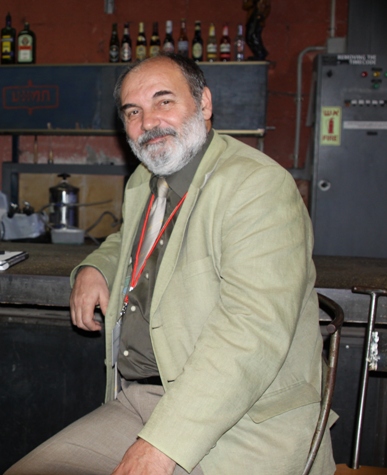
Image credit: Photo of Tarik Günersel by Elizur Reuveni

Comments are closed.