
“Everything is music” says Ruth Shakhash, the pianist and love interest of erstwhile best friends Itamar Yaacobi and David Leidental in Hanoch Levin’s play. In Maayan Even’s superb direction, everything is music, from the poetry of Levin’s words to Alex Kagan’s compositions, the mellifluous voices and captivating performances of the actors, and the piano at center stage. The grand piano is, in effect, the stage as it is part of a staircase studded with lights on which the action takes place, a stage within the stage. A backdrop of red curtains with luxurious folds of fabric completes the elegant, cabaret look of the set, infused with a sense of nostalgia that is complemented by the vintage-style pin-stripe suit and bowler hat worn by Yaacobi (Gal Zak) as he emerges from the open piano lid.
After years of friendship, playing dominoes and drinking tea every evening with his friend Leidental, Yaacobi announces that life is calling him, and his first step must be to sever all ties with Leidental (Shachar Netz), making his own life more meaningful by making his friend feel small and insignificant. The unsuspecting Leidental emerges mouse-like from within the depths of the piano, excited in his hesitant way about spending another evening with dominoes and tea, singing a song to friendship, “eternal and pure.” Levin’s critical gaze touches on every raw and vulnerable nerve of the psyche, and none are spared his scrutiny in this play, which has three protagonists, but no heroes, each searching for that elusive dream of happiness.
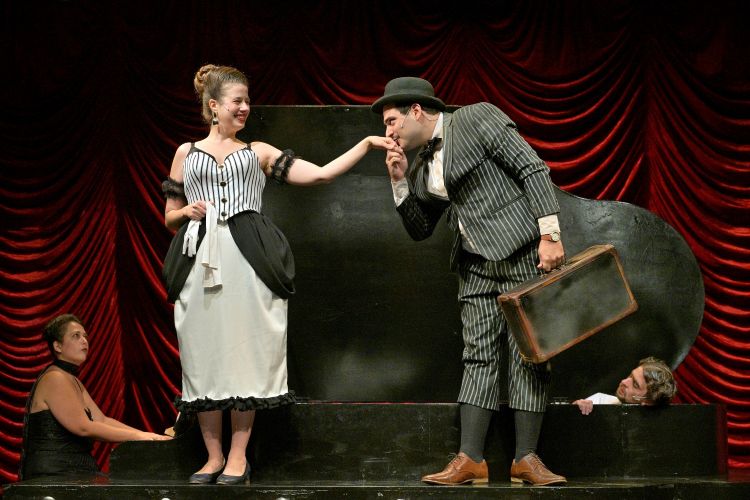
Levin’s acute perception and verbal agility are well matched in the staging and performance, which are as full of humor as they are insight to the human condition. Evoking the spirit of silent movies, slapstick, and musicals, every aspect of the play from costumes to pace and movement is replete with humor. Yaacobi’s trouser legs are much too short for him, while Leidental is drowning in a suit that is a few sizes too large – the fit of the costumes not only amusing, but reflecting their characters. Ruth Shakhash (Nitsan Levartovsky), ever strategic in her approach to relationships, is dressed to impress with a smart corset emphasizing her ample curves and “Big Tuches”. When Anna Benjamin, regal in an evening gown, makes her entrance at the start of the play, taking a seat at the piano, she sets the tone, establishing the fictional aspect of this world, and a measure of distance from which one can observe and enjoy the antics of the romantic triangle that ensues.
As much as Yaacobi is determined to rid himself of Leidental, so is Leidental tenacious in his pursuit of Yaacobi. The result is a comical and agile chase scene that briefly bursts into a dance number on the stairs. The verbal acrobatics are as graceful as the wonderful physical humor of the actors, each expressing his or her character in their pacing and intonation. Depicting extreme characters and situations, the play, in its music and stylized staging, evokes our laughter. As these three characters draw us deeper into their world, inevitably, we not only empathize with them in their human weaknesses and desires, we recognize ourselves.
Bold, incisive, poetic, and scathingly witty, Hanoch Levin’s works encompass comic and tragic plays, satiric cabarets, short stories, and songs, and his legacy lives on as a writer of almost mythic stature in Israeli culture.
Yaacobi and Leidental
A play with songs by Hanoch Levin
Director: Maayan Even; Original Music: Alex Kagan; Set Design: Noam Weiss; Costume Design: Michal Glazer; Musical Direction, Arrangement, and Performance: Anna Benjamin; Lighting Design: Rotem Elroy; Movement Design: Maya Witlin; Vocal Coach: Rebecca Bogatin; Production Manager: Judit Katz; Assistant Director: Tal Levy; Cast: Shachar Netz – David Leidental, Gal Zak – Itamar Yaacobi, Nitsan Levartovsky – Ruth Shakhash; Instrumentalist: Inbal Rosenhouse