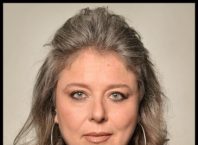
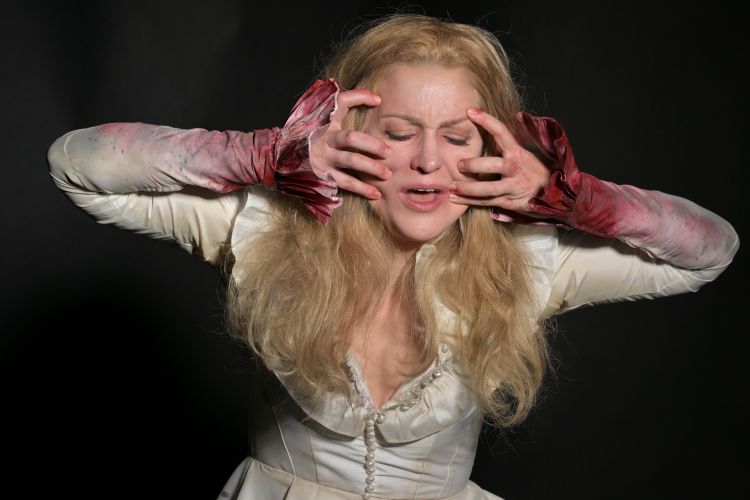
Celebrating its 40th season, the Israeli Opera announces the world premiere of a new, original, Israeli opera: The Dybbuk, by award-winning composer Joseph Bardanashvili with a libretto by Ido Ricklin. The first operatic adaptation in Hebrew of the classic play by S. An-Sky (Shloyme Zaynvl Rapoport 1863–1920), the opera will be directed by Ricklin, and under the baton of the Israeli Opera’s Music Director Dan Ettinger. Commissioning a new opera to mark the Israeli Opera’s 40th anniversary is part of the Israeli Opera’s endeavor to establish a repertoire of Israeli opera in Hebrew that is engaged in dialogue with Jewish and Israeli culture. The Dybbuk’s creative team includes Set Designer Heike Scheele, Choreographer Hillel Kogan, and Lighting Designer Adi Shimrony. The role of Leah will be performed by Alla Vasilevitsky, and the role of Hanan will be performed by Oded Reich. Performances will take place from February 18 – 25, 2025.
An-Sky’s play was originally written in 1913, following ethnographic research he conducted through Jewish towns in Russia to document the local Jewish folklore and culture. An encounter with a rabbi who specialized in expelling dybbuks and demons is considered to be the inspiration for the mystical love story of Leah and Hanan. An-Sky originally wrote the play in Russian and then translated it into Yiddish but lost the Yiddish manuscript when he fled Russia. He later reconstructed it based on Hayim Nahman Bialik’s Hebrew translation. However, war and revolution hindered his efforts to have the play staged, and it was not performed until 1920, in Warsaw, after his death. The play was a resounding success from its first performance, and following the Habima production in Moscow in 1922, directed by Evgenii Vakhtangov and starring Hanna Rovina as Leah, it played to audiences worldwide, becoming a cornerstone of Jewish culture. Over the course of the past 100 years there have been countless adaptations of The Dybbuk for theatre, cinema, dance, and television, as well as two operas, one of them in Yiddish. The Israeli Opera’s production is the first in Hebrew.
Director and librettist Ido Ricklin is well known for his interpretations of international operas such as Alcina (2022), and L’Italiana in Algeri (2021), and his original libretto in Hebrew and direction of the brilliant, bold, and deeply stirring, Theodor (2023). In An-Sky’s play Leah, the daughter of a rich man, and Hanan, a poor student, fall in love, but her father is set against it, and betroths her to a wealthier suitor. Hanan dies, and on the eve of her wedding, his spirit enters Leah, as a dybbuk (the word comes from a root meaning ‘to cling’ or ‘to adhere’). In the original play, Leah remains an enigmatic figure, however, in Ricklin’s libretto, Leah is given a complex voice, expressing inner thoughts and feelings. This transforms the work from a focus on mystical phenomena to a social-psychological drama. Leah is presented as a rebellious, stubborn, girl who grows up to become a silent, obedient, young woman. The meeting with Hanan, a poor Yeshiva scholar with a stormy spirit, turns her world upside down and ignites a love that can never be approved by her father. In the original play, Leah is torn between two worlds, that of the living and that of the dead. In the opera she is caught between the established, authoritarian, conservative, world represented by her father, and the world of emotions, passion, and freedom, represented by Hanan. Hanan in the opera is not only a scholar, but also a young man who is willing to overturn the social and divine order, and in his attempt to foil destiny, finds his death. That is the origin of the ‘dybbuk’. Through the voice of the deceased Hanan, Leah can express her rage and passion for the first time, rebelling against her father and the establishment of the rabbis, and the social order that constrained and silenced her.
Librettist and Director Ido Ricklin stated, “The story of The Dybbuk is about the spirit of a dead man that takes over the body of a woman. But I don’t think that the Dybbuk comes from the world of the dead. It comes from the depth of Leah’s tortured and silenced soul. It is not the voice of Hanan that is heard from Leah’s mouth, it is the voice of Leah herself.”
Award-winning composer Joseph Bardanashvili has been composing for over five decades, writing for the theatre, cinema, ballet, and opera. Bardanashvili read An-Sky’s play with an understanding of the many different musical worlds he has known, creating a composition that includes Ashkenazi and Georgian liturgy, Yiddish Purim spiel, forgotten Soviet avant garde, and influences of Gustave Mahler and Olivier Messian, as well as endless reflections of his personal voice and past works – among them his composition for a production of The Dybbuk at Habima in 1998.
Soloists in The Dybbuk will be: Leah – Alla Vasilevitsky (Soprano), Hanan – Oded Reich (Baritone), Old Beggar Lady – Yael Levita (Soprano), Sander – Ionut Pascu (Baritone), Frida – Rona Shrira (Contralto), Batya – Tamara Navoth (Mezzo-Soprano), Gitel – Efrat Bram Hacohen (Soprano), Tsadik – Yair Polishook (Baritone), Asher – Eitan Drori (Tenor), Henach – Odintsov Kirill (Baritone), 1st Cleansing Lady – Inbal Brill (Soprano), 2nd Cleansing Lady – Gal Kohav (Mezzo-Soprano), Balanit and 3rd Cleansing Lady – Yarden Kiperman.
Performances will take place: Wednesday, February 18th at 19:30; Friday, February 20th at 13:00; Saturday, February 21st at 20:00; Monday, February 23rd at 20:00; Wednesday, February 25th at 18:00.
Tickets may be purchased online from the Israeli Opera website.