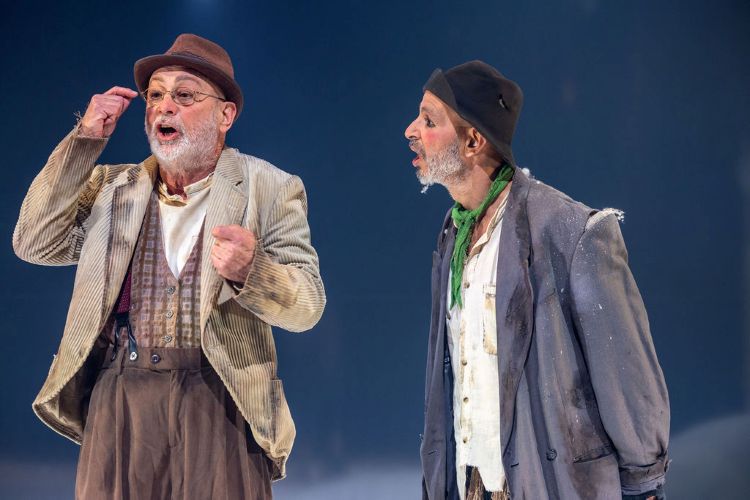
The Khan Theatre production of Waiting for Godot, directed by Udi Ben Moshe, reveals the playfulness, humor, and poignancy in Samuel Beckett’s play. In his staging, Ben Moshe connects to the minimalism of this classic work, letting the characters emerge through their body language and words, enabling them to be seen in their essential humanity. Two men, Estragon and Vladimir, no longer young, and looking the worse for wear, wait on a country road beside a tree for the enigmatic Godot, who has yet to arrive. The set design by Polina Adamov (who designed the costumes as well) is deceptively simple: a soft, snowy, empty, landscape against a black, reflective back wall, in which the characters’ blurred forms can be seen. Yet this black and white world is suffused in uncertainty. Intensifying the sense of mystery throughout the play is music by Didi Erez.
There is no pretense of verisimilitude – we know nothing about Vladimir and Estragon except what takes place onstage, the tree is represented by stage lights, its leaves by hanging cables. Beckett’s script often includes very detailed instructions for the characters’ actions, yet there is also great freedom in determining how those actions will be performed, which influences the emotional tone of the play. Yossi Eini imbues Estragon with childlike energy and physicality. His shoes pinch his feet, he’s always hungry, every now and then he curls up on the ground and goes to sleep, and tired of waiting, he always wants to go away. His clothes are ragged, his shirt torn, his pants held up by a scrap of cloth used as a belt. Vladimir (Erez Shafrir) is more reflective and responsible, steadily maintaining that they must wait for Godot, and his appearance reflects this. Although dirty and somewhat worn, his clothes are neat and proper, a vest and jacket covering his button-down shirt. His manner is graceful and elegant, even at one point performing a balletic leap. Yet, Beckett’s characters, much as they may philosophize, are always grounded in the reality of their bodies. Vladimir is no exception as he suffers, time and again, an urgent need to urinate, Shafrir punctuating the character’s mincing run with small yelps of woe. Although they argue intermittently and wonder if they should part ways, they are bound to one another and can no more part than they can cease waiting for Godot. When Estragon falls asleep, Vladimir sings to him and takes off his own coat to cover his fellow wanderer, then runs around in the cold, hugging himself trying to stay warm. Eini and Shafrir are at once endearing and hilarious, inviting the audience’s empathy.
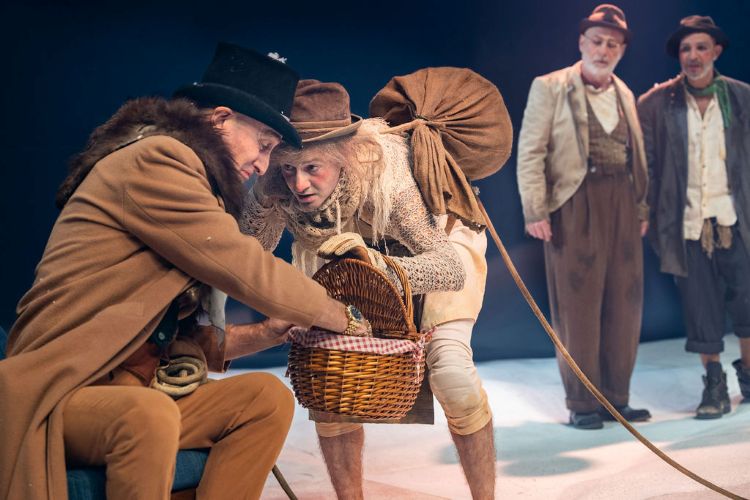
Into this stark world come two more travelers: Pozzo (Nir Ron) and Lucky (Itay Szor). Lucky, in white-face, is bent over under the weight of the burden he carries – a heavy sack, a wicker basket, and a chair. There is a thick rope around his neck, and Pozzo holds him by the rope. Nir Ron imbues Pozzo with droll pomposity, and his costume completes the image of a self-important man – a gold chain around his neck, a gold watch, top hat and a coat with a fur collar. The role of Lucky is a difficult one, as it is almost entirely without text. Itay Szor imbues Lucky with a touching vulnerability and even glimmers of a vivacious spirit in his body language and nuances of gaze and expression. Commanded to dance, Szor conveys the fragile beauty of a broken man barely capable of moving, as the snow falls delicately from above.
First performed in 1953, Waiting for Godot has been performed worldwide countless times since then, each production presenting its own view of the play. In a play permeated with a sense of futility and uncertainty, Udi Ben Moshe’s staging, in its lightness, simplicity, humor, and beauty reverberates with the humanity of its characters, revealing the empathy Estragon and Vladimir feel for Lucky, for one another, and ultimately, poignantly and profoundly, universal empathy, as Vladimir asks, “Was I sleeping, while the others suffered?”
Waiting for Godot
By Samuel Beckett
Directed by Udi Ben Moshe
Translated into Hebrew by Yosef El-Dror
Set and Costume Design: Polina Adamov; Music: Didi Erez; Lighting Design: Roni Cohen; Production Manager: Keren Or Gadon; Assistant Director: Nimrod Etzion; Cast: Yossi Eini – Estragon, Erez Shafrir – Vladimir, Nir Ron – Pozzo, Itay Szor – Lucky, Eytan Goldstein/Itamar Kuba Grossman/Eyal Padan – The Boy