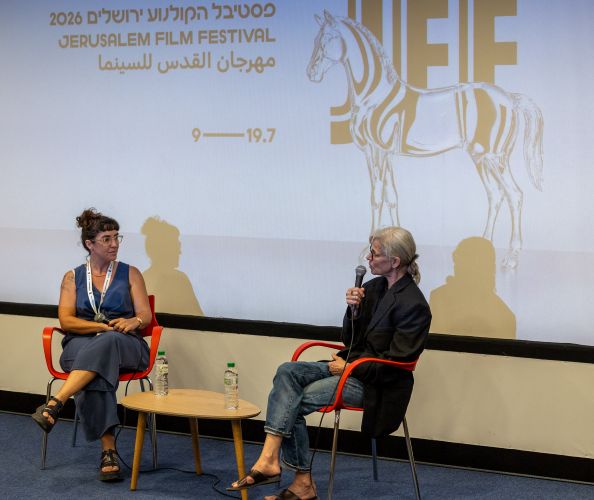
One of the great pleasures of the film festival is the opportunity to talk about a film with the filmmaker. Award-winning writer and director Angela Schanelec conversed with Yaara Ozery following the screening of her film My Wife Cries at the Jerusalem International Film Festival, offering insight into her creative process and perspective on film.
My Wife Cries opens with a white metal chair set against a white wall, reminiscent of a blank canvas. Into the room walks Thomas, a crane operator at a construction site, and begins a conversation with the women in the office. The camera is focused on Thomas, one hears the women speak but they are not seen unless they walk into the frame – as they do at one point, to see photographs. Thomas is informed that his wife called, and when he goes to meet her, he finds her sitting on a bench, crying.
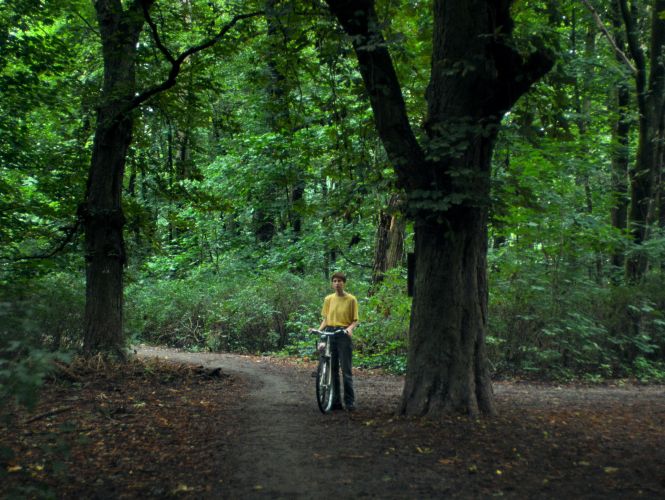
Much like in Greek tragedy, a critical event has happened “off-stage” and is recounted by Carla, Thomas’s wife, as she and Thomas head out to work the next morning on their bikes. The film follows Thomas, Carla, the woman who works in the office and her ex-husband, Carla’s co-worker at the kindergarten, Claudia, and Laszlo – a father who brings his son David to the kindergarten. In their conversations, the different protagonists express their thoughts, desires, and fears, in a film that explores relationships and language itself, the way it reveals and conceals, the chasms that can open between a couple, as each interprets and responds differently to the same event.
As is perhaps apparent from the description above, Schanelec’s film does not follow a traditional narrative arc. It is a film that raises questions, offers moments of insight and reflection, as well as moments of evanescent beauty – like the impromptu choreography that is created when rain falls on a band playing in the park.
Schanelec shared with the audience that she began writing the screenplay while she was waiting for financing for her previous film, during this time she said, “when you can do nothing” there was a construction site very close to her home, and she decided to set her film there, saying “I started imagining a man coming in and starting to talk.”
One aspect of the film that stands out is the characters’ speech, which has a very neutral, even tone. When asked about this, Schanelec responded, “I don’t know if it’s realistic or naturalistic or authentic, I do not work with these terms. I work with words.”
“When I write a dialogue I imagine someone saying something and the more I imagine this person the more concrete it becomes. It’s not realistic, when we talk about realistic we mean that someone tries to show you something someone playing but the camera was not there. So they show us maybe what we could have seen in life but actually what you maybe could have seen in life – it’s just too beautiful, it’s precious… What I actually wanted to say: that’s not what I do. I do not pretend that this is just happening somewhere because I don’t think… why should I do? you can also look at yourself or look at a friend or sit on a bench and look at the people.”
Schanelec does indeed work with words, and the words spoken by the film’s protagonists draw the viewer into their world. Yet it is not all words, the images move beyond the construction site into scenes of nature, and even a spontaneous group dance to the sound of Leonard Cohen’s Lover, Lover, Lover. Just like the protagonists of My Wife Cries, each viewer will have their own perspective and interpretation of the film, with images and phrases that resonate in the mind long after the film is over.
There will be additional screenings of My Wife Cries on Tuesday, July 14th and Thursday, July 16th. Tickets are available on the festival website.