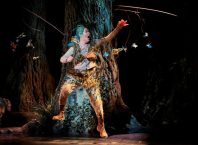
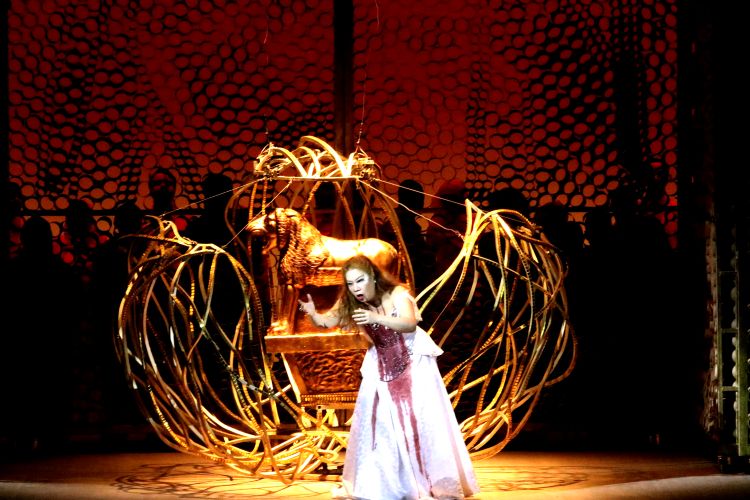
Celebrating its 40th anniversary season, the Israeli Opera will present Giuseppe Verdi’s Nabucco from June 12 – 27, 2026. A co-production with the Minas Gerais Opera House in Brazil, the opera will be directed by André Heller-Lopes and conducted by Carlo Montanaro. An Italian-language opera in four acts with a libretto by Temistocle Solera, the opera focuses on the historical figure of Nabucco, Nebuchadnezzar II, King of Babylon, who destroyed the First Temple, and the plight of the Jews.
One of the most active opera stage directors in Latin America, André Heller-Lopes has directed productions all over Brazil and also in countries such as Germany, Spain, Argentina, Portugal, Chile, Colombia, Uruguay, Poland, Germany, Austria, UK, Estonia, Malaysia and the USA. He will come to Israel for the first time for Nabucco. Heller-Lopes describes Nabucco as an opera dealing with questions of identity, community, faith, and constant change. He views the Jewish people as a community composed of diverse voices, traditions, memories, and ways of thinking, and this abundance of questions, doubts, and arguments is part of what defines them as a community throughout the generations. Heller-Lopes emphasizes that even the protagonists in the opera are not fixed characters or one-dimensional, but rather humans in a continuous process of change and growth, moving between jealousy, rebellion, faith, compassion, and hope. He further states that for him, as a Jew, directing Nabucco as part of the Israeli Opera’s 40th season is an especially meaningful personal moment. He connects his family’s history in Europe to the feeling of “returning” to Israel, and related that the inspiration for this production’s design originated in his first visit to Tel Aviv and his encounter with works relating to Jewish memory at ANU Museum of the Jewish People. Heller-Lopes stated that for him, Nabucco is a work about people living between the past and the future, and a community that continues to develop and change.*
The premiere of Nabucco in 1842 heralded the emergence of a new voice in opera – Giuseppe Verdi. It was not Verdi’s first opera, he had already composed two operas, Oberto, which premiered in 1839 and was well received, and Un giorno di regno. However, during the composition of the latter, Verdi’s wife Margherita died, this following the early deaths of both their children. Un Giorno di regno was a failure, with only one performance at La Scala, and Verdi decided to cease composing music.
However, the La Scala impresario, Bartolomeo Merelli, convinced him to read Temistocle Solera’s libretto, and eventually, Verdi composed the opera, which was originally titled Nabucodonosor. According to one version of this story, Verdi threw the libretto down, the book opened on a random page, and his eyes fell on the phrase “Va, pensiero, sull’ali dorate (Fly, thought, on golden wings), destined to become the Chorus of the Hebrew Slaves, one of the most popular songs of the opera. In these challenging times, the Chorus of the Hebrew Slaves has acquired new meaning, and poignant resonance.
Nabucco’s libretto is based on the biblical books of 2 Kings, Jeremiah, Lamentations, and Daniel, and on the 1836 play by Auguste Anicet-Bourgeois and Francis Cornu. As the Babylonian army converges on Jerusalem, the Israelites pray. Although the situation is grim, there is some hope for peace, as they hold a hostage: Fanena, Nabucco’s younger daughter. Guarding Fanena is Ismaele, the nephew of the King of Jerusalem and a former envoy to Babylon. Fanena and Isamaele are in love. The romantic and political plots become even further entangled as Abigaille, Nabucco’s elder daughter, enters Jerusalem in disguise, and as one might guess, Abigaille is also in love with Ismaele. She is also in love with power.
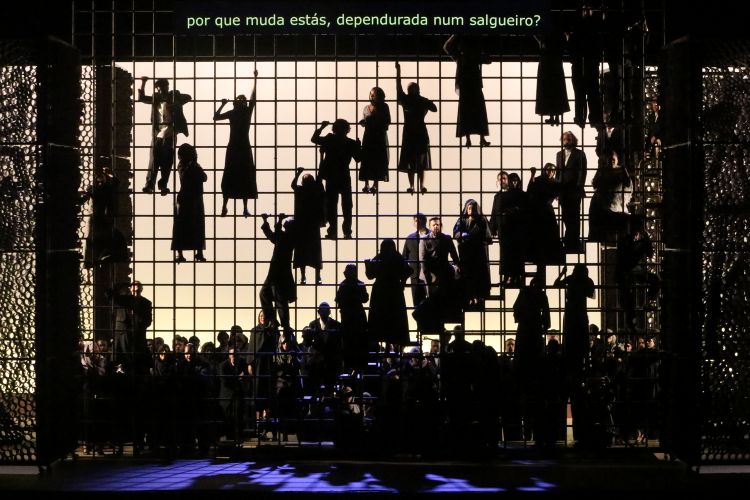
Nabucco was resoundingly well received at its first performance at La Scala on March 9, 1842, in which famed soprano Giuseppina Strepponi (who was to become Verdi’s second wife) sang the role of Abigaille. The plight of the Jews in exile may well have resonated for audiences at the time, echoing the state of Italy, which had not yet been unified, with part of the country under Austrian rule, and the rest split into small independent states. Although it is difficult to determine the extent of Verdi’s political involvement, and whether he intended Nabucco to have a meaningful subtext for the Italian people, the Risorgimento movement for the unification of Italy was on the rise, and Nabucco, and Verdi, became associated with the cause, as the Chorus of the Hebrew Slaves became its unofficial anthem.
Soloists in Nabucco: Mikolaj Zalasinski (Baritone) and Ionut Pascu (Baritone) alternating as Nabucco; Pavel Petrov (Tenor) as Ismaele; Vazgen Gazaryan (Bass) and Godzerdzi Janelidze (Bass) alternating as Zaccaria; Elena Mikhailenko (Soprano) and alternating as Abigaille; Julija Vasiljeva (Soprano); Shay Bloch (Mezzo-Soprano) and Rachel Frenkel (Mezzo-Soprano) alternating as Fanena; Oded Reich (Baritone) and Pnini Leon Grubner (Bass) alternating as High Priest; Eitan Drori (Tenor) and David Goldberg (Tenor) alternating as Abdallo; Shaked Strul (Soprano), Dalia Besprozvany (Soprano), and Ekaterina Michaeli (Soprano) alternating as Anna. Featuring The Israel Symphony Orchestra Rishon LeZion, and The Israeli Opera Chorus with Choir Conductor Itay Berckovitch.
Performances will take place at the Israeli Opera from June 12 – 27, 2026. Tickets and additional information are available on the Israeli Opera website.
*Director André Heller-Lopes comments are paraphrased based on a press release in Hebrew.