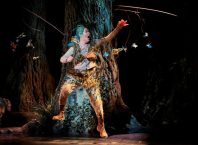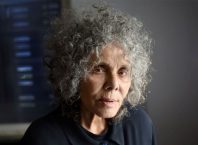
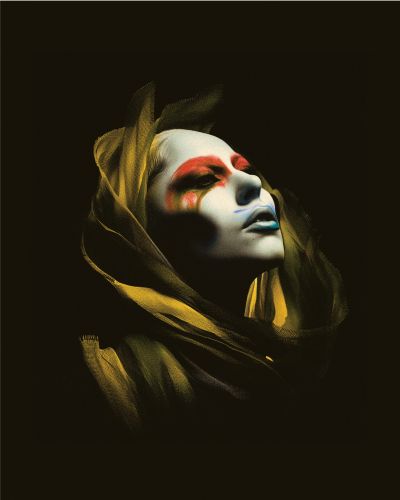
The Israeli Opera will close its 40th season with an exciting new production of Giacomo Puccini’s Tosca, directed by Ido Ricklin, and conducted by Maestro Dan Ettinger. Together with the creative team of Set Designer Herold Falko, Costume Designer Ula Shevtsov, and Lighting Designer Nadav Barnea, they present an intriguing, contemporary perspective on the opera: the timeless classic in a world of cameras, surveillance, and social networks. Performances will take place from July 17 – 30, 2026.
A suspenseful political thriller and love story, Tosca has art and artists at its heart, who are pitted against a cruel authoritarian regime. Composed by Puccini to a libretto by Luigi Illica and Giuseppe Giacosa, the opera premiered in Rome at the Teatro Costanzi in January 1900. The plot is set in Rome of 1800, against the backdrop of Napoleon’s attempt to rule Italy.
Cesare Angelotti, a pro-Napoleon political prisoner, having escaped from his cell in the Castel Sant’Angelo, hides out in the Church of Sant’Andrea della Valle. When the artist Mario Cavaradossi comes to work on his painting of Mary Magdalene, he discovers the escaped prisoner and offers to help him. The opera singer Floria Tosca is Cavaradossi’s lover. When she sees that his painting resembles the Marchesa Attavanti (Angelotti’s sister), she becomes jealous, but is reassured by Cavaradossi and departs. Events take a turn when Napoleon’s defeat is announced and Tosca comes to the church once more to tell Cavaradossi that she cannot meet him because she must sing at a celebration taking place in the palace. When she does not find him there, she rushes off to his villa – but – Police Chief Scarpia, who lusts after Tosca, has her followed by his agent Spoletta. The suspense builds from scene to scene before arriving at its dramatic conclusion.
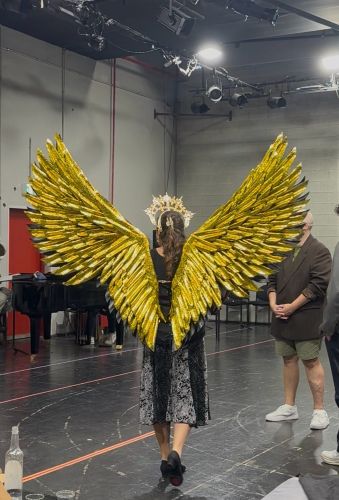
The new original production sets the story in a time similar to our own: a world of security cameras, surveillance, unlimited governmental power, and a culture of constant public exposure. According to Director Ido Ricklin, the aim is not to “update” Puccini, but rather to create an experience for today’s audiences that will have the same power and emotional impact that audiences felt at the opera’s premiere in 1900. “It is a classic not because it is old,” Ricklin stated, “but because in every generation it succeeds in saying something urgent and relevant. I tried to ask, what was the impact that Puccini wanted to have on the audience, and how can I create that today…I wanted the audience to feel that these events can happen anywhere – and perhaps are already happening.”
In the current production Tosca and Cavaradossi are depicted as successful artists who feel detached from the political reality around them, until it bursts into their lives and forces them to contend with a world of violence, oppression, and loss of liberty. Scarpia, is not an aristocratic Baron of the 19th century, but a gray and chilling administrator, who operates a modern, and all too familiar system of control.
Soloists in Tosca: Elena Mikhailenko (Soprano) and Anna Nechaeva (Soprano) alternating as Tosca; Alexey Dolgov (Tenor) and Eduardo Aladrén (Tenor) alternating as Cavaradossi; Mikolaj Zalasinski (Baritone) and Ionut Pascu (Baritone) alternating as Scarpia; Oded Reich (Baritone) and Yair Polishook (Baritone) alternating as Angelotti; Yuri Kissin (Bass) and Yoav Ayalon (Bass) alternating as Sagrestano; Anthony Webb (Tenor) and Adi Ezra (Tenor) alternating as Spoletta; Pnini Leon Grubner (Bass) and Kirill Odintsov (Baritone) alternating as Sciarrone / Carceriere; Tal Ganor (Soprano) as A Shepherd boy. Featuring The Israel Symphony Orchestra Rishon LeZion, and The Israeli Opera Chorus with Choir Conductor Itay Berckovitch, and the children’s Moran Choir.
Performances will take place at the Israeli Opera from July 17 – 30, 2026. Tickets and additional information are available on the Israeli Opera website.